
The American kestrel is a small falcon with a habit of turning an open field into a hunting ground. At our place, I see them use the nest boxes we put up and hear their sharp, repeated killy, killy, killy calls when the young are active. We have watched them long enough to notice that every brood has its own surprises.
A small falcon built for open country
The American kestrel was once called a sparrow hawk, although small birds are only part of its diet. It also catches insects and small mammals. Cornell Lab of Ornithology describes the kestrel hunting from a perch or hovering into the wind before dropping onto prey. That hovering is why some people call it a hover hawk.
Male and female kestrels are both colorful, but they do not look identical. The male has blue-gray wings and a rusty back. The female has rusty wings and back marked with dark bars. Both have dark marks on the face. They are about the size of a robin, but their pointed wings, long tail, and way of holding themselves tell you that you are looking at a falcon.

What You’ll Learn
The family in our nest boxes

Kestrels use cavities such as tree holes and abandoned woodpecker holes. They will also use nest boxes. We have had them nest in boxes on our property year after year. In one photograph, the box holds four eggs. In another, you can see the young calling and flapping as an adult arrives with food.

The birds do not carry in twigs to build the kind of nest you might picture for a songbird. I once put wood shavings in our boxes, but starlings moved in and built their own nests, which I removed. Since then, I have left our boxes bare. That is an observation from our property, not a general instruction for every box. If you plan to put one up, follow a current NestWatch American kestrel box plan and local guidance on placement, material, monitoring, and cleaning.
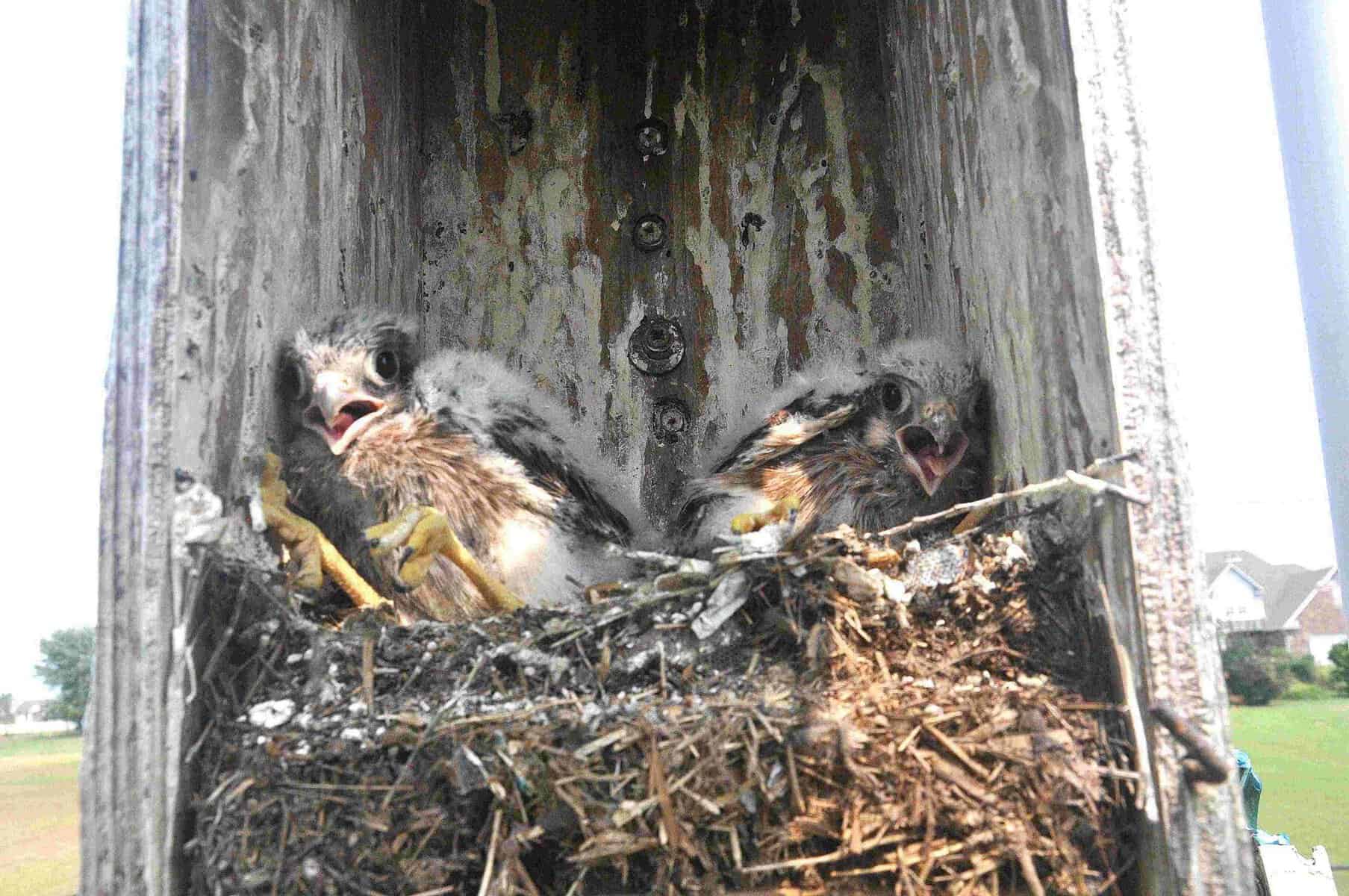
I have seen broods with more males than females, and one year all four young birds were female. The variation keeps me checking the box each season.

A falcon named Ariel
Years ago, while I was in graduate school, I trained a kestrel for falconry. Her name was Ariel. I wish I had pictures of her, but I do not.
I thought retirement might give me time to return to falconry. It did not. A falconer has to give a bird daily time and attention, and the maintenance of our property took precedence. Watching wild kestrels raise young in the boxes has become a different way to stay close to these remarkable little falcons.
If you enjoy watching birds around a homestead, my guide to hawks in Oklahoma shows several other raptors that visit our area.