

A duck house can look roomy until the birds come in wet, shake water across the floor, and settle into the one corner you expected to keep clean. Duck house size and setup work best when the plan begins with usable dry floor, not the building’s outside dimensions.
Ducks need protection at night, fresh air above the resting area, bedding you can remove without crawling through the doorway, and drinking water close enough to reach without turning the sleeping bed into a puddle. The layout has to manage moisture every day, not only during the first week after construction.
Measure the flock and the cleanout route together. A shelter that fits the birds but not the person carrying out wet bedding will become harder to maintain than it needs to be.
Duck house size and setup start with usable floor
In her Cooperative Extension guide to raising backyard meat ducks, Dr. Jacquie Jacob of the University of Kentucky recommends shelter with at least 4 square feet per duck. This reference comes from meat-duck housing guidance. It is not a legal standard or a guarantee that every adult flock will fit comfortably.
For a hypothetical flock of six ducks, multiplying six by four gives 24 square feet. Allow equipment space separately so the birds retain that much usable floor. A water station or feeder occupying part of a 24-square-foot house leaves less room for resting and moving.
Measure the interior rather than relying on outside dimensions, and mark where equipment will sit and where the doorway opens. Look at the remaining floor as a connected space: ducks should be able to settle, turn and reach the exit without squeezing through an equipment bottleneck.
A sketch helps you compare two houses with similar outside dimensions. Draw the water station, feeder and nesting area at their intended positions, then trace the route between the entrance and clear resting floor. Equipment that fits individually can still leave an awkward passage when everything is in place.
Coop height and elevated roosts do not add to that sleeping floor. Larger birds and longer periods confined indoors are reasons to reconsider the layout and allowance. A house used only for overnight shelter faces different demands from one holding the flock through extended bad weather.
Make entry and cleanout part of the floor plan
An existing chicken coop may work if it provides enough accessible floor space. Many domestic ducks sleep in bedding rather than on high roosts, so assess the lower level before counting upper platforms as useful accommodation.
Allow for your breed’s behavior rather than assuming every duck will use the house the same way.
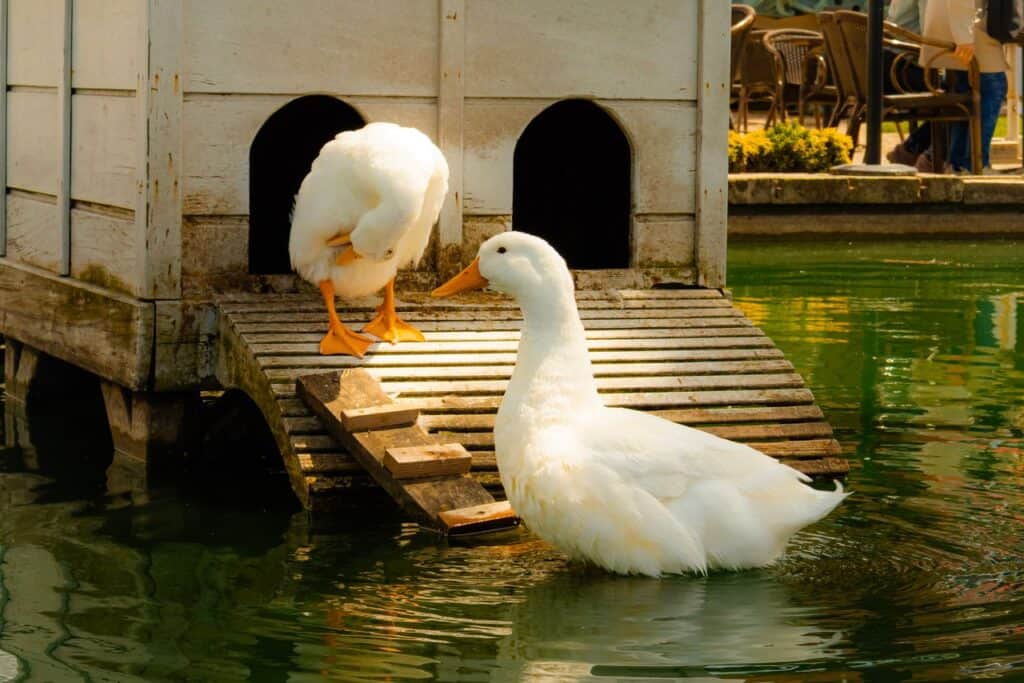
Choose a low, roomy entrance, with a gentle, nonslip ramp wide enough for the birds if a ramp is unavoidable. Check its condition when it is wet, since an entrance that works on a dry afternoon may be awkward in mud or ice.
Cornell’s duck-housing guidance warns against rough, abrasive or sharp flooring that can injure feet and hocks. Keep this in mind around the doorway and water station as well as under the bed. Exposed wire is not an automatic solution to wet flooring.
Our guide to adapting a chicken coop for ducks treats cleaning access as part of the design. Check that your shovel or bedding fork fits through the cleanout opening and reaches the back corners. An attractive house becomes much less appealing when removing wet bedding means crawling through the duck door.
Low nesting corners or ground-level nesting options should remain easy to reach and re-bed. Avoid placing them where every trip to the water station crosses the nesting area. Keep enough open floor around them for the birds to move.
Keep the water available and the sleeping bed separate
Site the house on high, well-drained ground. A dry interior is harder to maintain when runoff collects against the wall or crosses the entrance. Check where roof water lands, too, rather than letting it empty onto the birds’ route inside.
The Cornell Duck Research Laboratory housing guidance describes placing waterers outside to reduce water tracked into litter in its semi-confinement growing system. It also specifies providing water indoors when temperatures fall below freezing. Outdoor placement is conditional on weather, access and protection, not permission to leave ducks with frozen or unreachable water.
For a backyard house, plan a separate wet zone wherever the flock can safely reach it. Water inside needs a cleanable splash area that keeps overflow away from resting bedding. The surface ducks stand on must remain safe for their feet, and any catchment or drainage needs to be accessible for cleaning.
Do not solve the mess by removing all drinking water while feed remains available. Our duck feeding and water-station setup guide connects the two: birds need reachable water near their feed, while the feed itself should stay dry. Moving the waterer should preserve that access.
Check water access with the night doors closed: a waterer on the other side of a locked door is no longer available to the birds inside. If the water station must move indoors, allow for its footprint and the splash area instead of putting it into the only remaining resting corner.
A swimming pool does not belong in the sleeping bed. Cornell’s basic duck-care guidance distinguishes essential clean drinking water from swimming water, which is not essential. You can keep the resting area dry without trying to fit every water activity under the same roof.
Judge bedding below the surface
Cornell identifies dry, absorbent straw or shavings for a small home flock; choose material you can keep clean and replace when needed. There is no useful bedding winner if the house’s layout leaves it constantly soaked.
Inspect the bed daily, including the layer below a dry-looking surface, concentrating on the water side, entrance and favorite resting spots. Remove soaked or caked material, renew the bedding and check that the remaining bed provides a dry resting surface.
Fresh material on top cannot compensate indefinitely for saturation underneath. Cornell describes renewing litter and cleaning out the old material when necessary. Treat deep bedding as a system that still requires inspection and removal, rather than a reason to keep covering a wet floor.
The workload changes with flock size, weather, water placement and how long the birds stay inside. Let the condition of the bed determine when it needs a full cleanout. Check conditions and respond before the bed is wet throughout.
During a cleanout, look at the exposed floor and the edges beneath the old litter. A persistent wet strip against one wall deserves a check for water entering there before you refill the house. Replacing bedding without looking underneath can leave the same problem waiting under the fresh layer.
Access affects how well that routine works. If the only wet patch is beyond your reach, enlarging the cleanout opening may be more useful than trying another bedding material. Leave yourself room to remove the problem without dismantling the house each time.
Ventilate through winter without blowing across the bed
Enclosed duck houses need air exchange even when the weather is cold. Cornell notes that windows and ridge openings may provide adequate ventilation for small flocks, while larger enclosed operations may need mechanical systems. Assess the air exchange in the shelter you have, including whether its openings stay clear and protected.
The Cooperative Extension poultry-housing guidance explains that outgoing air carries away moisture, ammonia and carbon dioxide. Closing every opening to conserve warmth leaves that moisture inside. Dry bedding and ventilation have to work together.
Protected upper openings can let damp air escape without directing cold wind across resting ducks. Look at the bed’s position relative to the opening, especially on the side facing prevailing wind. Openings also need weather protection so rain does not enter with the fresh air.
Judge the arrangement at resting height as well as near the roof. An upper opening and a gap beside the bed expose ducks differently, even though both admit air. Correct the direct wind path without treating every opening as a leak that needs to be sealed.
Cover vents and windows with securely fitted, appropriate heavy-gauge mesh. Ventilation and security should be planned together; leaving an uncovered opening to solve stale air creates another problem. Check that coverings have not become blocked or pulled loose.
Condensation on walls or the underside of the roof calls for attention to moisture and air exchange. Ammonia odor also calls for action, but your nose is not a calibrated safety instrument. Do not wait for a strong smell before checking litter, water spills and ventilation.
Trace recurring wet spots before changing the whole house
A wet patch beside the waterer suggests checking for splash, overflow or a leaking container. Remove the saturated bedding and watch where water goes during use. If it keeps escaping the wet zone, changing that zone’s containment or position may help more than adding bedding around it.
Wetness at the doorway after rain calls for a different inspection. Look outside for runoff, standing water and the route the ducks take into shelter. Check whether roof water lands at the threshold or whether wet feet are carrying water across the bed.
Roof or wall moisture may be condensation, but after a storm, inspect the roof and joints for leaks rather than assuming every damp ceiling needs more vents. The location and timing of the wetness help you decide what to investigate; they do not prove a cause.
When the entire bed stays damp, consider water placement, drainage, cleaning frequency, crowding and airflow together. A larger vent cannot drain standing water out of the floor. A new bag of shavings cannot repair a roof leak.
Correct housing problems you find, but take concerning breathing, movement or other health changes to an avian or poultry veterinarian rather than assuming ventilation or fresh bedding will treat an illness.
Check every route into the night house
Predator proofing means inspecting the whole enclosure, including its smallest openings. The Cooperative Extension predator-management guidance describes raccoons reaching through wire and weasels entering very small gaps. Chicken wire should not be treated as equivalent to a suitable exclusion barrier.
Use strong, small-opening mesh appropriate to local threats, secured mechanically to sound framing; opening size and wire strength both matter. No single mesh size guarantees protection from every predator, and strong wire attached to rotten wood leaves a weak edge.
Follow the house’s joins: roof to wall, wall to floor, door to jamb and house to run. Check hinges, loose trim, rotten boards and the gap below the door. An earth-floor house needs an appropriate barrier against entry underneath; bare ground is not a secure bottom.
A latch needs to resist manipulation as well as hold the door shut, and it must engage fully without bedding blocking the threshold. Where the run meets the house, inspect the join rather than assuming the two structures protect each other’s gaps.
Make night lockup a routine before dark:
- Count the ducks inside the protected enclosure.
- Close and lock the doors, then check latch engagement.
- Look for new digging, loose mesh or widened gaps around the house and its connection to the run.
- Remove feed spills and recheck damage after storms.
Outdoor digging barriers and overhead protection need their own inspection. Our predator-proof duck run guide covers that next task in more detail. We also keep more duck-care guides together for related flock questions.
Stand in the doorway and picture carrying one load of soaked bedding out without moving a wall or crawling into a corner. What would you change before adding ducks?
Frequently Asked Questions About Duck House: Size, Dry Bedding, Ventilation, and Predator Proofing
How much space do ducks need in a house?
Space recommendations vary with breed, climate, time confined, and whether feed and water are inside. Use guidance appropriate to your flock, then make sure every duck can rest without crowding and that you can reach the whole floor.
Do ducks need water inside their house at night?
Ducks need access to drinking water that lets them clear their nostrils, but indoor water can saturate bedding quickly. The answer depends on confinement time, weather, predators, and a water station designed to contain splashing.
Does a duck house need ventilation in winter?
Yes. Ducks release considerable moisture through breath and wet feathers. Provide fresh air above the birds while protecting the resting area from direct drafts and blowing precipitation.
What is the best bedding for a duck house?
Choose clean, absorbent bedding you can source, store dry, and remove easily. No bedding can compensate for a leaking roof, poor drainage, or a water station that continually floods the floor.