
Types of snapping turtles in Oklahoma usually come down to two native heavyweights: the common snapping turtle and the alligator snapping turtle. David’s original pond note focused on the one he had actually seen, the common snapper, including one active under winter ice and another moving across land during nesting season.
This refresh keeps those real homestead observations but adds clearer field marks, safety context, and current Oklahoma Wildlife Department guidance. Snapping turtles are not monsters, pets, or pond decorations. They are long-lived wetland animals with powerful jaws, specific habitat needs, and a very good reason to be left alone.
Types of Snapping Turtles in Oklahoma
Oklahoma has common snapping turtles and alligator snapping turtles. The Oklahoma Department of Wildlife Conservation common snapping turtle profile describes the common snapper as a large aquatic turtle with a long tail, saw-toothed tail projections, a large head, webbed feet, a small lower shell, and a shell that may lose obvious ridges as the turtle ages.
ODWC describes the alligator snapping turtle as Oklahoma’s largest turtle and the largest freshwater turtle in North America. It has a stronger hook-like beak, three prominent ridges on the shell, and a smoother tail. It is much more restricted in Oklahoma than the common snapper.
Key Takeaways
Common Snapping Turtles Around Ponds
The common snapping turtle is the one David has seen again and again. He has found them throughout the year, including under the ice of a winter pond where one was still moving and searching for food. That detail stands out because many other pond turtles slow down or become inactive when the weather turns cold.
Common snappers spend much of their time in ponds, sloughs, creeks, and slow water where mud, logs, and aquatic cover help them disappear. When they are in the water, they are usually more interested in staying hidden than causing trouble. The tense encounters usually happen on land, where the turtle feels exposed and cannot retreat quickly.
If you want more context for the pond community around them, read David’s guide to pond turtles. Snappers are part of the same wetland story, but they do not behave like basking sliders or box turtles crossing the yard.
How to Identify a Common Snapping Turtle
A common snapping turtle looks old even when it is not. It has a big head, hooked jaws, a long thick tail, rough-looking skin, and a shell that is often muddy, algae-covered, or worn smooth with age. Unlike many turtles, it cannot pull its whole body neatly inside the shell for protection.

That lack of full shell protection explains a lot of its attitude on land. If bothered, cornered, or handled, a common snapper can strike with speed and reach farther than people expect. The safest field mark is often distance: look, photograph if you can do it without crowding the turtle, and let it keep moving.

David’s photo of a snapper up near a tree is a good reminder that they are not glued to the pond. Snapping turtles may travel between water bodies, especially after rain or during nesting season. Seeing one away from water does not automatically mean it is lost.
Nesting Season and Baby Snapping Turtles
Female common snapping turtles leave the water to nest, often in late spring or early summer. David photographed one laying eggs in spring, and that is one of the few times people notice snappers far from the pond. The turtle may be slow, focused, and vulnerable, but she still needs space.

Do not move a nesting turtle unless she is in immediate danger, such as the middle of a busy road. If you must help, move her only in the direction she was already going and never pick her up by the tail. A tail lift can injure the spine. Use distance, patience, and common sense.
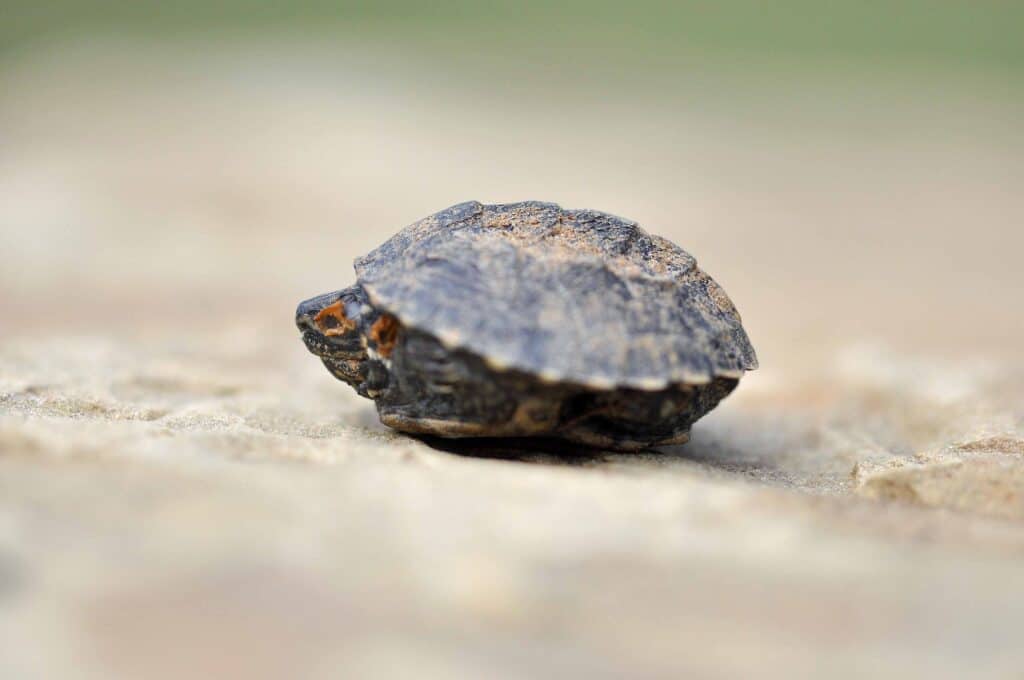
Baby snapping turtles are tiny compared with the adults, but they are already built like snappers. They face a hard start. Nests and hatchlings are vulnerable to many predators, and the short trip from nest to water can be dangerous. If you find a baby snapper, admire the small prehistoric look and let it continue toward cover.
Alligator Snapping Turtles in Oklahoma
The alligator snapping turtle is the species David has searched for but has not yet found. That fits its secretive reputation. Alligator snappers tend to stay in water, especially river systems, lakes, sloughs, and slow, shaded habitat. They are not the turtle most Oklahoma pond owners are likely to meet.
Alligator snappers are bigger and heavier than common snappers. ODWC notes their large adult size, hooked beak, three prominent shell ridges, and smoother tail as helpful differences. The alligator snapper can also lure prey with a worm-like appendage inside its mouth, one of those facts that sounds made up until you learn it is real.
Because alligator snapping turtles are a conservation concern in Oklahoma, check current rules before attempting to handle, collect, or possess any reptile. ODWC’s reptile and amphibian regulations list alligator snapping turtles under the statewide closed season.
Snapping Turtle Safety for Homesteads and Roads
Most snapping turtle problems begin when a person tries to hurry, lift, poke, or relocate one without a reason. On a homestead, the better answer is usually space. Keep children and dogs away, give the turtle an escape path, and let it leave at its own pace.
If a turtle is crossing a farm driveway or lane, watch from a distance until it finishes. If it is on a public road and you can safely help without risking yourself, move it in the direction it was headed. Never put your hands near the head. Never grab the tail. Never assume a turtle is harmless because it looks slow.

David’s winter ice photo is one of the most memorable parts of the original article. It also shows why pond wildlife rarely follows neat human schedules. Snappers can be active when other turtles are not, and the life under a frozen pond may be busier than it looks from the bank.
How Snapping Turtles Fit Into the Pond
Snapping turtles eat a wide variety of animal matter and carrion. That can make people suspicious of them, but predators and scavengers are part of a pond system. One turtle does not mean a pond is ruined. It means the pond has enough life to support something large and wild.
For a wider look at Oklahoma wildlife around water and wet ground, compare this article with Oklahoma frogs, box turtles, and types of snakes in Oklahoma. The same rule keeps showing up: identification first, respect second, interference only when truly needed.
Product and Lasso Opportunities
This article does not need affiliate pressure. Natural product fits would be a regional reptile field guide, waterproof field notebook, long-handled road-safety shovel, or trail camera for pond edges. Add real Lasso shortcodes only after specific products are chosen. Do not invent prices, ratings, IDs, or affiliate URLs.
Let Snapping Turtles Keep Their Wildness
Snapping turtles are easy to turn into a warning story, but they are more interesting than that. They are ancient-looking, stubborn, wary, and deeply tied to water. David has seen them under ice, sunning on logs, nesting in soil, and moving where a person does not expect a turtle to be.
That is enough reason to give them room. Learn the difference between common and alligator snappers, keep your hands away from the front half, check the current rules, and let the turtle finish its own errand. For another close look, see snapping turtles of Oklahoma.
Frequently Asked Questions About Types of Snapping Turtles in Oklahoma
What types of snapping turtles live in Oklahoma?
The two types of snapping turtles in Oklahoma are the common snapping turtle and the alligator snapping turtle. The common snapper is the one most people are more likely to encounter around ponds and slow water.
Are the photos in this article common or alligator snapping turtles?
The live article photos show common snapping turtles. David noted that he has searched for alligator snapping turtles but has not found one.
Are alligator snapping turtles legal to collect in Oklahoma?
Check current ODWC regulations before handling or collecting any reptile. As of this update, ODWC lists alligator snapping turtles under the statewide closed season.
What should I do if I find a snapping turtle in the road?
Only help if you can do so safely. Move the turtle in the direction it was already going, keep hands away from the head, and never lift a snapping turtle by the tail.
Do snapping turtles stay active in winter?
Common snapping turtles can be active in cold conditions. David’s original observation included a common snapper moving under the ice in a winter pond.