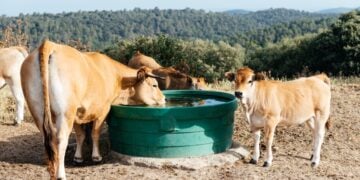

Every cattle owner eventually gets tired of the same thirty seconds: stop the truck, get out, swing the gate, drive through, get out again, close the gate. Multiply that by six trips a day and the appeal of a cattle guard becomes obvious fast. But a cattle guard is a permanent piece of infrastructure with real engineering behind it, and on a small property it is not automatically the right answer. This is how to decide, what the specification actually requires, and where a plain gate still wins.
If your perimeter is not sorted yet, start there instead. Our guide to cattle fencing that actually holds a cow covers the perimeter decisions that need to be settled before you think about access points at all.
What You’ll Learn
How Does a Cattle Guard Actually Work?
A cattle guard is a grid of parallel rails set over a pit at a fence opening, level with the road surface, so vehicles drive across it and livestock will not.
The mechanism is worth understanding because it explains every failure mode. Cattle do not avoid a guard because the gaps are too wide to step over. A determined animal could physically cross one. They avoid it because cattle place their feet deliberately and will not commit weight to a surface where they cannot see and feel solid ground underneath. The visual depth of the pit and the instability of the rails underfoot together tell the animal that this is not walkable, and she declines.
That has a direct practical consequence. A cattle guard that fills with dirt, gravel, manure, or snow stops working, because once the pit is packed to within a few inches of the rails, the visual depth disappears and the animal reads it as solid ground. Guards need periodic cleaning out, and a guard installed without adequate drainage will silt in faster than you expect. This is the single most common reason a working cattle guard suddenly stops containing animals, and people usually blame the cattle rather than the pit.
Cattle that have already crossed one successfully are much harder to contain afterward, the same way cattle that have beaten a fence once become repeat offenders.

Cattle Guard Specifications: What the Standard Requires
Cattle guards intended for vehicle traffic are engineered products, and the public specifications are worth reading before you buy anything.
State highway drawings, such as the Montana Department of Transportation’s cattle guard standard drawings, specify HS20 live loading, which is the standard highway truck loading rating and the figure you want on anything a loaded feed truck, hay delivery, or fire apparatus will cross. Standard sections come in 8, 10, and 12 foot widths, with complete guard lengths assembled in 16, 20, 24, 30, 32, 36, and 40 foot options depending on how wide the crossing needs to be.
Rail spacing runs at roughly 18 to 19 inch centers, with the drawings specifying five spaces at approximately 1 foot 6 inches for an 8 foot section. Installation calls for excavating 2 feet below the elevation of the bottom of the guard base, with interior fill brought back to about 1 foot 6 inches, and two wings are required for every installation to tie the guard into the adjacent fence line so animals cannot simply walk around the end of it.
That last point catches people. A cattle guard without proper wings is an expensive ornament, because cattle will route around it within days.
Cattle Guard vs. Gate: The Real Tradeoff
The honest comparison comes down to frequency of use, cost, and what happens when something goes wrong.
A cattle guard wins at a main driveway entrance you cross many times a day, at an entrance where visitors and delivery drivers arrive who cannot be trusted to close a gate behind them, and anywhere the habitual gate-closing failure is a person rather than the hardware. That last case is the strongest argument for a guard: a gate only works if every single human who passes through it closes it, and over a year of deliveries, guests, and tired evenings, someone will not.
A gate wins almost everywhere else on a small property. It costs a fraction as much, it can be moved or repurposed, it works during a flood or a heavy freeze when a guard pit may be full, and it lets you close off a paddock completely when you need to. For interior pasture divisions and crossings you use a few times a week, a gate is the better engineering and financial decision by a wide margin.
There is also a middle option most people overlook: a cattle guard with a hinged gate alongside it. The guard handles routine vehicle traffic, and the gate opens when you need to move animals through, bring in equipment too wide for the guard, or close the opening entirely. On a working property this combination is often the right answer rather than a compromise.

What a Cattle Guard Costs
The guard itself is only part of the number, and this is where budgets go wrong.
A steel cattle guard rated for real vehicle loading is a significant purchase on its own, and the installed cost typically runs well above the price of the unit once you account for excavation, a base or footings, drainage, gravel, and the wings that tie it into your fence. If you do not own or rent equipment capable of the excavation, add contractor time. Compare that against a good farm gate with proper posts, which is a small fraction of the total and something one person can install in an afternoon.
The rule of thumb worth applying: if you are not crossing this opening at least several times a day, the gate is cheaper for its entire service life, including the value of your own time spent opening it. Fencing and access are usually the largest one-time infrastructure line on a new cattle property, so it belongs in your planning from the start. Our guide to building a homestead budget covers how to sit a cost like this inside your broader numbers instead of treating it as a surprise.
Will a Cattle Guard Hold Other Livestock?
Usually not, and this is a common and expensive assumption on a mixed homestead.
Cattle guards are designed around the foot placement and weight of cattle. Sheep, goats, and smaller stock frequently cross them, either by picking their way across the rails or by jumping. Goats in particular treat a cattle guard as a mild puzzle rather than a barrier. If you run mixed species through the same entrance, plan on a gate or on a guard with much tighter rail spacing specifically rated for small ruminants, and test it before you trust it. Our guide to sheep fence covers why containment standards for smaller stock are a genuinely different problem from cattle containment.
Horses are a separate caution. Horses can and do get legs caught in cattle guard rails, with serious injury results, and many horse owners will not use them at all.
Common Cattle Guard Mistakes
Skipping the wings. Covered above and worth repeating, because it is the most common installation failure. Cattle walk around the ends.
Under-rating the load. A guard rated for pickup traffic will fail under a loaded hay truck or a fire engine. Buy for the heaviest vehicle that will ever cross it, including emergency vehicles you have not thought about.
No drainage plan. A pit that holds water silts in, freezes, and stops working. Grade the site so water leaves the pit rather than collecting in it.
Never cleaning it out. Put guard cleaning on the same seasonal list as fence walking. A guard is not maintenance-free infrastructure, it is low-maintenance infrastructure, and the difference matters the first time you find your herd standing in the road.
Assuming it works on day one. Watch your cattle around a new guard before you rely on it. Animals that were raised around guards respect them immediately. Animals that have never seen one sometimes need to work out what it is, and a small number will test it in ways you want to observe while you are standing there. How much fence and infrastructure a given animal will genuinely respect depends partly on size and temperament, which our guide to choosing cow breeds for milk, meat, or both covers breed by breed.
Frequently Asked Questions
How does a cattle guard work?
Cattle will not put weight on a surface where they cannot see solid footing underneath. The visual depth of the pit and the feel of the rails tell the animal it is not walkable, so she declines to cross. This also means a guard that fills with dirt, snow, or manure stops working, because the visual depth disappears and it reads as solid ground.
What size is a standard cattle guard?
Standard sections come in 8, 10, and 12 foot widths, assembled into complete guards of 16, 20, 24, 30, 32, 36, or 40 feet. Rail spacing runs at roughly 18 to 19 inch centers. Highway drawings specify HS20 live loading, which is the rating you want for anything a loaded truck will cross.
Is a cattle guard better than a gate?
A cattle guard is better at a main driveway you cross many times a day, especially where delivery drivers and visitors cannot be relied on to close a gate. A gate is better almost everywhere else on a small property, since it costs a fraction as much, can be moved, and lets you close an opening completely.
How deep does a cattle guard need to be installed?
Highway specifications call for excavating about 2 feet below the elevation of the bottom of the guard base, with interior fill brought back to roughly 1 foot 6 inches. Two wings are required for every installation to tie the guard into the fence line, otherwise cattle simply walk around the ends.
Will a cattle guard hold sheep or goats?
Usually not. Cattle guards are designed around the foot placement and weight of cattle, and smaller stock frequently pick their way across or jump. Goats treat them as a puzzle rather than a barrier. Horses are a separate concern, since they can catch a leg in the rails and be seriously injured.