
Anyone who has tried to milk a goat that would rather be anywhere else understands the appeal of a good goat milking stand within about thirty seconds. The stand gives the goat a place to stand, a bucket of feed to focus on, and a gentle headlock that keeps it there, which turns milking from a wrestling match into a calm, repeatable routine. It is one of the most useful pieces of equipment a goat keeper can own.
And it earns its keep far beyond the milk bucket. The same stand that holds a doe for milking holds any goat for hoof trimming, grooming, vaccinations, and the regular health checks that goats need. Here is how to choose or build the right one, and how to size it so it actually fits your animals.
Key Takeaways
What a Goat Milking Stand Does (Beyond Milking)
A goat milking stand, sometimes called a stanchion, is a raised platform with a head-locking gate at the front. The goat hops up, reaches its head through the stanchion to get at a feed bucket, and the gate closes around its neck to hold it gently in place while it eats. The raised platform brings the goat, and specifically its udder, up to a height where you can work without bending double.
If you plan to milk, this is close to essential, and it pairs directly with learning how to milk a goat, since a still goat and an accessible udder are half the battle. But the stand’s usefulness does not stop at dairy. A securely held goat on a raised platform is exactly what you want for trimming hooves, which every goat needs regularly, as well as for grooming, giving shots, checking eyelids for signs of parasites, and any other hands-on task.
This is why plenty of people who keep goats for brush clearing, fiber, or as companions build a stand anyway. It makes the routine handling that comes with goat ownership safer for you and less stressful for the animal. If you are just starting out with goats, a stand belongs near the top of your equipment list right alongside good fencing and shelter.

Build or Buy: Which Goat Milking Stand Is Right for You?
The first real decision is whether to build a stand yourself or buy one. Both are legitimate, and the right answer depends on your budget, your tools, and how much storage space you have.
- DIY wooden stand: built from lumber using any of the free plans floating around, a wooden stand costs roughly the price of the boards and hardware and is well within reach of a beginner woodworker. It is heavy and permanent, which is fine if it lives in one spot, and it is easy to customize to your goats’ size.
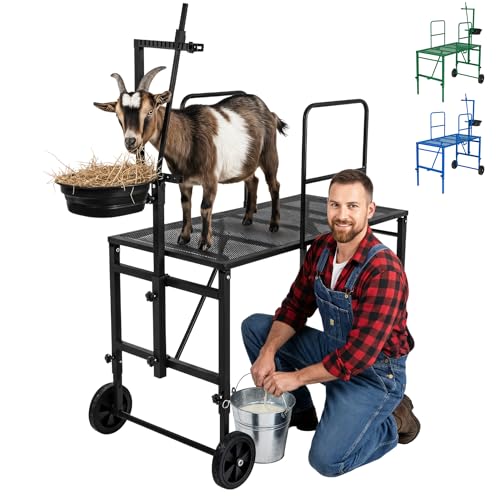
- Commercial metal stand: a welded steel stand costs more but is durable, easy to hose clean, and, in the folding versions, stores flat against a wall when not in use. If you are short on barn space or milk in a spot you need to clear between uses, the fold-flat feature alone can justify the price.
For a permanent milking area with room to spare, a sturdy DIY wooden stand is hard to beat on value. For a tight space, a rented barn, or anyone who would rather buy than build, a metal folding stand is the convenient choice. Neither is wrong, and both will last for years if built or bought to a decent standard.
Goat Milking Stand with Feeder, Rails & Wheels, Stanchion for Grooming & Hoof Trimming, Sheep Stand for Shearing Heavy-Duty Steel Platform
Features That Make a Good Milking Stand
Whether you build or buy, a few features separate a stand you will love from one that frustrates you every morning. The details are simple but they matter, because you will use this thing daily.
The headlock stanchion should close smoothly and adjust to hold the goat’s neck securely without pinching, and it needs to be easy for you to open and close one-handed while your other hand is busy. A feed bucket or trough that mounts at the front is what keeps the goat happily occupied, so make sure the design includes one or has an obvious place to add it. The platform surface should give the goat’s feet some grip, since a slick surface makes a goat nervous and fidgety, and a nervous goat is a hard goat to milk.
Sturdiness is non-negotiable. A goat that feels the platform wobble will not settle, and a determined goat can shift a light stand across the floor. It needs to hold the animal’s weight and its movement without rocking. And a stand that is easy to wipe or hose down keeps your milking area sanitary, which is part of the broader hygiene that good goat care essentials depends on.
Step-by-Step Guide to Build a Sturdy Wood Milking Stand for Dairy Cows, Goats & Small Livestock

Size It to Your Goats
This is the detail people most often get wrong, especially with miniature breeds. A goat milking stand has to fit the goat, and a stand sized for a full-grown Nubian or Alpine is simply the wrong shape for a Nigerian Dwarf.
For standard dairy goats, a platform around 15 to 18 inches high works well and brings the udder to a comfortable height. The stanchion opening needs to be wide enough for a full-size neck. For miniature breeds, everything scales down: a lower platform so a small goat can step up easily, and a narrower headgate so it actually holds a slim neck rather than leaving the goat able to pull its head back out. The differences between breeds are covered in our guide to choosing a dairy goat breed, and they extend to your equipment, not just your feed and housing.
If you keep both standard and miniature goats, you may need two stands or a genuinely adjustable one, because a compromise height suits neither well. Getting the fit right is what makes the goat comfortable enough to stand calmly, which is the entire point. A well-fitted stand is a small investment that pays back every single milking, and it is one more reason the the benefits of raising goats add up to something manageable rather than a daily struggle.
However you go about it, do not treat the stand as an afterthought. Alongside the reputable, breed-specific guidance from sources like Penn State Extension, a properly sized, sturdy milking stand is foundational equipment that shapes how pleasant, or how miserable, your daily goat chores will be.
Frequently Asked Questions About Goat Milking Stands
What is a goat milking stand?
A goat milking stand, also called a milking stanchion, is a raised platform with a head-locking gate at one end. The goat steps up, puts its head through the stanchion to reach a bucket of feed, and the gate closes gently around its neck to hold it in place. The raised platform brings the udder up to a comfortable height so you can milk without bending double.
Do you really need a milking stand for goats?
You can technically milk a cooperative goat without one, but a stand makes the job vastly easier and is strongly recommended. Beyond milking, the stand holds a goat securely for hoof trimming, grooming, shots, and health checks, which are a constant part of goat keeping. Even people who do not milk often build a stand just for that routine handling.
Should I build or buy a goat milking stand?
Both are good options. Building a wooden stand from free plans costs roughly the price of the lumber and a bag of hardware, and a solid DIY stand lasts for years. Buying a metal folding stand costs more but gives you durability, easy cleaning, and the ability to fold it flat for storage, which matters if you are short on space. Choose based on your budget, your tools, and how much room you have.
How tall should a goat milking stand be?
The platform is usually about 15 to 18 inches off the ground for standard dairy goats, which brings the udder to a good height whether you milk sitting on a stool or standing at a low bench. The right height also depends on your own comfort, so if you are building one, set it so you are not hunching over. For miniature breeds, a lower platform works better.
Will a milking stand work for Nigerian Dwarf goats?
Only if it is sized for them. A stand built for full-size goats has a platform too tall and a stanchion too wide for a Nigerian Dwarf or other miniature breed, leaving a small goat unable to reach the feed comfortably or held loosely by an oversized headgate. Build or buy a stand scaled to minis, with a lower platform and a narrower neck opening.