

A heated cat house sounds like spoiling them right up until the first night it drops into the teens and you are standing in the barn wondering where everybody went. Barn cats are tougher than most people give them credit for, but that toughness runs out somewhere. Whether a cat comes through winter in good flesh or comes out of it thin and sick usually comes down to one thing, which is having somewhere genuinely warm to curl up.
Here is what surprises people. Most of the warmth in a good winter shelter has nothing to do with electricity. It comes off the cat herself. A small, snug, well-insulated box catches her body heat and holds it, while a box that is too big, too drafty, or packed with the wrong bedding stays cold no matter what you plug in. The heater is the last ten percent. The box is the other ninety.
Key Takeaways
Do Outdoor Cats Actually Need a Heated Cat House?
Look at your winter, your cats, and what they already sleep in before you buy anything. Be honest about all three before buying anything. A healthy adult cat with a thick coat, good body condition, and access to a dry draft-free hay loft handles far more cold than most people assume. Cats grow a genuine winter coat, they seek out heat sources, and they are extremely good at finding the warmest cubic foot in any building. If your cats disappear into a straw stack every November and come out fine every March, your system is already working.
The cats who need help are the ones without that option. Short-haired cats and the more lightly built breeds carry less insulation than the dense-coated ones we cover in our guide to the best barn cat breeds. Kittens have a small bodies that shed heat fast, older cats and those with arthritis or any chronic condition have less reserve, and a cat recovering from illness or injury has none at all. Any cat on a property with no enclosed building is working without a net.
There is one more consideration worth weighing. The ASPCA offers the blunt general guidance that if it is too cold for you, it is probably too cold for your pet. That advice is written for house pets and it does not translate directly to a working cat who has lived outside her whole life. It still makes a useful gut check when the forecast turns genuinely severe, and there is no shame in a barn cat spending a subzero week in the garage.
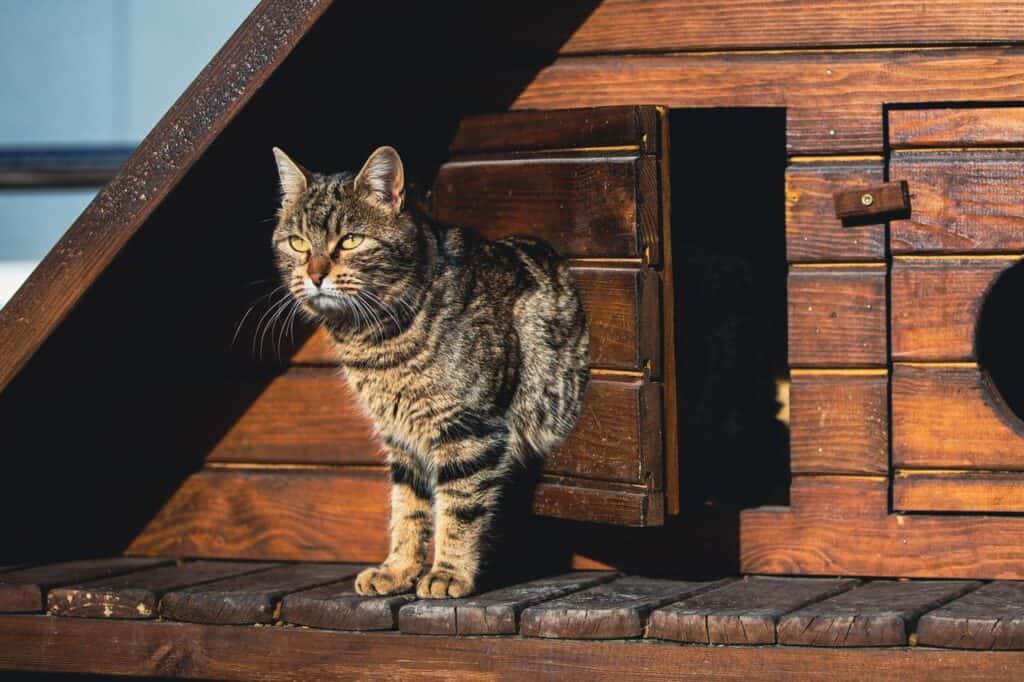
Why Box Size Matters More Than Wattage
People skip straight to the heater and wonder why the box still feels cold. Size is why. A heated cat house works with the cat rather than instead of her, and a cat generates a fairly small amount of heat. In an enclosed space that heat warms the air, the air warms the walls, and if the space is small and insulated the whole box comes up to a comfortable temperature and stays there. Put the same cat in a large doghouse and that heat disperses into a volume she can never warm, so she is sleeping in a cold box with a roof on it.
The target for a two-cat shelter is roughly two feet by three feet and about eighteen inches high. That feels cramped to a human eye, and it is supposed to. If you have more cats, build or buy multiple boxes rather than one large one. Cats pile together voluntarily, which is efficient and worth encouraging, but they need the option of a space small enough to actually warm up.
The entrance matters as much as the footprint. Six to eight inches across is the target, which is big enough for a cat and small enough to limit heat loss and keep out most predators and larger wildlife. An entrance offset to one side rather than centered lets her curl into a corner out of the direct draft line. A vinyl flap over the opening helps considerably, though plenty of cats need a week with the flap propped open before they will push through it.
Raise the box off the ground by four to six inches on blocks or a pallet. Ground moisture wicks upward into a shelter sitting flat on dirt, and frozen soil pulls heat straight out through the floor. This single step costs nothing and makes a real difference on the coldest nights, which is the best return you will find anywhere in this project.
Straw, Not Hay, and Definitely Not Blankets
If you remember nothing else, remember this. More people get bedding wrong than get anything else wrong out here. Straw is the correct bedding. Straw is the hollow stem left after grain harvest, and those hollow stems trap air, which is what insulation actually is. It sheds moisture rather than absorbing it, and a cat can burrow into loose straw and build herself a nest that stays dry and stays warm.
Hay is dried grass grown as animal feed, and it behaves in exactly the opposite way. It absorbs moisture readily, packs down flat, grows mold, and in cold weather freezes into a solid cold mat. It looks similar to straw at a glance and costs about the same, which is precisely why so many people get this wrong. Ask for straw specifically when you buy, and check what you are actually loading into the truck.
Blankets, towels, and fleece are the worst option of the three despite being the most intuitive. Fabric absorbs moisture from the air and from the cat’s own breath and paws, and once damp it holds that wet against her body all night. Wet bedding in freezing weather is worse than no bedding at all. If you have already put an old quilt into a shelter, pull it out and replace it with straw before the weather turns.
Refresh the straw whenever it packs down or takes on any damp, which in a wet winter means every few weeks rather than once a season. Budget for more straw than you think you need, because the bale you bought in October will be flat and tired by January. We go deeper into the whole cold weather setup in our guide to keeping barn cats safe in cold weather, and bedding is the item most worth getting right first.
What a Heated Cat House Adds
Get the box right first and a heater turns into a real upgrade. Get it wrong and no heater saves you. A heated cat house comes in three forms, and they suit different situations. Self-warming pads contain a reflective layer that bounces the cat’s body heat back at her, requiring no power, with nothing to fail and nothing to chew. The effect is modest but real, and for an unpowered outbuilding they are often your only realistic option.
Heated pads and mats are the most common approach and the most flexible. Look for a low-wattage unit, typically twenty to forty watts, that is thermostatically controlled to warm to roughly the cat’s body temperature rather than running hot. Two features matter for safety above all others: a chew-resistant cord, usually steel-wrapped, and an automatic shutoff. Place the pad so it covers part of the floor rather than all of it, because cats regulate temperature by relocating and a uniformly warm floor removes that choice.
Waterproof Heated Cat Mat, Pet Warmer for Outside Feral Cat Houses, Indoor Outdoor Warming Pet Mat - Small 12.5x18.5in Black 40W

A fully built heated cat house is an insulated shelter with the heating element already integrated. These are convenient, generally well designed, and more expensive than assembling the parts yourself, which makes them worth it if you would rather make one decision than four. Whichever route you take, the electrical safety points are not negotiable in a barn.
Elevated Weatherproof Insulated Heated Outdoor Cat House for Winter - Feral Cat Shelter for Outside Cats - Outdoor Heated Cat House (Green)

Use an outdoor-rated extension cord sized for the load, plug into a GFCI-protected outlet, keep every connection off the ground and out of standing water, and run the cord where rodents cannot reach it. A chewed cord in a hay-filled building is a barn fire, and that risk is not theoretical. The same wiring discipline applies to anything you power through winter, including the setups in our guide to winterizing the chicken coop.
Water Freezes Before Cats Do
Spend your first hundred dollars somewhere other than a heated cat house. A cat tolerates cold air for a long time, but she cannot tolerate having no water. Cats on a dry food diet get nearly all their moisture from drinking, so a frozen bowl means a full day or more without water in conditions that already raise her caloric and fluid demands.
Dehydration in cold weather causes decline faster than the cold itself does, and it contributes directly to urinary problems that are both common and expensive in cats. A heated water bowl for cats solves this for roughly the cost of a decent heated pad. Look for the same features you want in any heated equipment, meaning thermostatic control so it runs only when needed, a chew-resistant cord, and enough capacity that it is not running dry between your checks.

Place the water away from the sleeping box, because a cat should never have to choose between drinking and staying dry. Any splash near bedding creates the exact wet-bedding problem you worked to avoid, and a heated cat house with damp straw in it is no warmer than an unheated one. Snow is not a substitute either, since eating snow costs her body heat to melt it and delivers very little water for the effort.
Food demand rises in winter too, by a meaningful margin, because maintaining body temperature burns calories she has to get from somewhere. Cats need more food and more fat through the cold months, which we work through in detail in our guide to feeding working farm cats. A cat with a warm box and inadequate calories is still losing ground all winter.
Placement and the Winter Hazards Nobody Mentions
Tuck the box out of the wind, against a building wall on the downwind side, with the door facing away from the weather. Somewhere the cats already go beats somewhere convenient for you every time. If you set up a beautiful shelter in a spot they have never used, expect it to sit empty all winter while they sleep in the straw stack as usual. Two shelters beat one if you have several cats, both for heat retention and because it gives a lower-ranking cat an option when the dominant one claims the good box.
Two winter hazards deserve naming, because they kill cats every year and neither has anything to do with temperature. The first is antifreeze. The ASPCA warns that antifreeze is lethal to dogs and cats, recommends cleaning up spills thoroughly, and suggests using propylene glycol-based products rather than ethylene glycol versions. Ethylene glycol tastes sweet, cats will drink it, and a very small amount causes fatal kidney failure.
On a homestead full of equipment and vehicles, check for leaks and puddles as part of your winter walkthrough, and keep the ASPCA Poison Control line, (888) 426-4435, somewhere you can find it.

The second is engine compartments. Cats climb into warm engine bays to sleep and are killed or badly injured when the vehicle starts. Bang on the hood and check underneath before starting any vehicle that has been parked in the cold. It takes three seconds and it is the easiest cat’s life you will ever save.
The Order to Buy In
If you are starting from nothing, spend your money in this order and you will get the most out of every dollar. First comes an insulated, correctly sized, raised box with a small offset entrance. Second is straw, in quantity, with more set aside for refreshing it. Third is a heated water bowl. Fourth is a heated pad or a full heated cat house.
That sequence puts your money where the returns are largest, and it means that if you only get through the first two items before the weather turns, your cats are already in decent shape. A working cat who comes through winter in condition is hunting in March rather than recovering through April. That is the actual return on this spending, and it is why cold weather setup belongs in the core routine alongside everything else in our complete guide to keeping working cats on the homestead rather than filed under optional extras.
Frequently Asked Questions About Heated Cat Houses
How Cold Is Too Cold for an Outdoor Cat?
A healthy adult cat with a thick winter coat, good body condition, and a dry draft free shelter handles freezing temperatures well. Kittens, older cats, short haired cats, and any animal that is thin or unwell have far less reserve. If conditions are severe enough that you would not stay out in them, bring vulnerable cats into a garage or outbuilding.
What Is the Best Bedding for a Heated Cat House?
Straw. It is hollow, traps air, and sheds moisture rather than absorbing it. Do not use hay, which absorbs moisture, packs flat, and freezes into a cold mat, and do not use blankets, towels, or fleece, which hold damp against the cat and leave her colder than no bedding at all.
How Big Should an Outdoor Cat Shelter Be?
Roughly two feet by three feet and about eighteen inches high for two cats. It should feel small, because the shelter works by trapping the cat’s own body heat, and a larger box disperses that heat into a volume she cannot warm. For more cats, use multiple boxes rather than one large one.
Is a Heated Cat House Safe to Use in a Barn?
Yes, with the right equipment and wiring. Choose a low wattage thermostatically controlled unit with a chew resistant steel wrapped cord and automatic shutoff. Use an outdoor rated extension cord on a GFCI protected outlet, keep all connections off the ground, and route the cord where rodents cannot reach it.
Do I Need a Heated Water Bowl for Cats Too?
Often it is the more important purchase. Cats on dry food get nearly all their moisture from drinking, and a frozen bowl means a full day or more without water in conditions that already raise fluid demand. Dehydration causes decline faster than cold does, and snow is not a substitute.
Why Won’t My Cats Use the Shelter I Built?
Usually placement or the entrance flap. Cats use spaces they already trust, so a shelter in a new location may sit empty while they keep sleeping in the straw stack. Move it somewhere they already go, face the entrance away from prevailing wind, and prop any vinyl flap open for a week.