

Most ducks start laying eggs between 4 and 7 months of age, depending on breed. When do ducks start laying eggs on the earlier end of that range? Khaki Campbells and Indian Runners often begin at 4 to 5 months and rarely miss a beat once they start. Heavier breeds like Pekins and Muscovies take closer to 6 to 7 months to reach laying maturity. The breed you choose sets your baseline, and everything else — daylight, nutrition, and stress levels — determines whether your ducks hit that baseline or fall behind it.
What You’ll Learn
When Do Ducks Start Laying Eggs by Breed
Breed is the most reliable predictor of when your ducks will start laying. Knowing what to expect from the breed you are raising saves a lot of unnecessary worry during those last weeks before the first egg appears.
Khaki Campbell ducks are the most prolific layers in the domestic duck world, often producing 250 to 340 eggs per year. They typically begin laying at 4 to 5 months old and are one of the few duck breeds that rivals or outpaces chickens for sheer egg volume. If eggs are your primary goal, Campbells are the standard.
Indian Runners are another high-production breed that starts laying young, usually at 5 to 6 months. They stand upright and run rather than waddle, which makes them efficient foragers, and their egg production is strong through their first several years.
Pekin ducks are the most common backyard breed and reliable layers, but their size means they mature more slowly. Most Pekins begin laying at 6 to 7 months. They average 125 to 225 eggs per year, fewer than Campbells, but their calm temperament and dual-purpose nature make them a favorite for mixed homestead flocks.
Muscovy ducks are the outliers. They are not closely related to other domestic breeds and behave differently in almost every respect, including egg laying. Muscovies typically begin laying at 6 to 7 months and lay in clutches of 8 to 15 eggs with breaks in between, rather than laying steadily year-round. Annual production averages 60 to 120 eggs. They are exceptional mothers and will go broody readily, which makes them valuable for hatching, but their production numbers do not compare to purpose-bred laying breeds.
Rouen ducks look like large mallards and are primarily kept as ornamental or meat birds. They begin laying at 6 to 7 months and produce 35 to 125 eggs annually. If consistent egg production is your goal, Rouens are not the best fit.

How Daylight Affects When Ducks Start Laying Eggs
Daylight is the most powerful environmental factor controlling when ducks start laying eggs. Duck reproductive systems are triggered by light exposure, specifically the increasing day length that comes with spring. A duck that reaches laying age in late fall or winter may delay her first egg until days start getting longer, even if she is otherwise fully mature and well-fed.
The threshold for consistent laying is 14 to 16 hours of light per day. In natural conditions, this corresponds to spring and early summer. Ducks raised in regions with significant seasonal variation will often hold off through the short days of November through January, then begin laying as February and March bring longer light.
If you want eggs year-round or need your pullets to start laying on schedule regardless of season, supplemental lighting solves the problem. A simple timer-controlled bulb in the duck house that brings total daily light up to 14 to 16 hours is enough to trigger and maintain production. The light does not need to be bright. A single 40-watt incandescent bulb or equivalent LED in a 10 by 12 foot space is sufficient. Increase light gradually rather than switching it on all at once, adding 15 to 30 minutes per week until you reach the target.
Signs Your Ducks Are About to Start Laying
Ducks give clear physical and behavioral signals in the weeks before their first egg. Knowing what to look for helps you get nesting boxes ready and set expectations accurately.
The most noticeable physical sign is a widening of the pelvic bones. On a duck that is approaching laying age, you can gently place two fingers between the pelvic bones. A gap of two finger-widths or more indicates she is close. A tight gap means she has more time. This is the same check used with chickens and is equally reliable in ducks.
Behaviorally, ducks approaching laying age will start investigating corners of the pen, shuffling bedding material around, and spending more time in nesting areas. They may squat when you reach toward them, a submissive posture that signals sexual maturity. Drakes in the flock will show increased mating interest, which is another reliable indicator that the females are nearing readiness. If you are still sorting the males from the females, our guide to how to sex ducks explains the voice, feather, size, and behavior clues.
What the First Eggs Look Like
The first eggs a duck lays are often smaller than what she will produce at full production, and occasionally oddly shaped or thin-shelled. This is completely normal. A young hen’s laying system is still calibrating, and it takes a few weeks to settle into a consistent rhythm. Shell quality and egg size even out on their own as she matures.
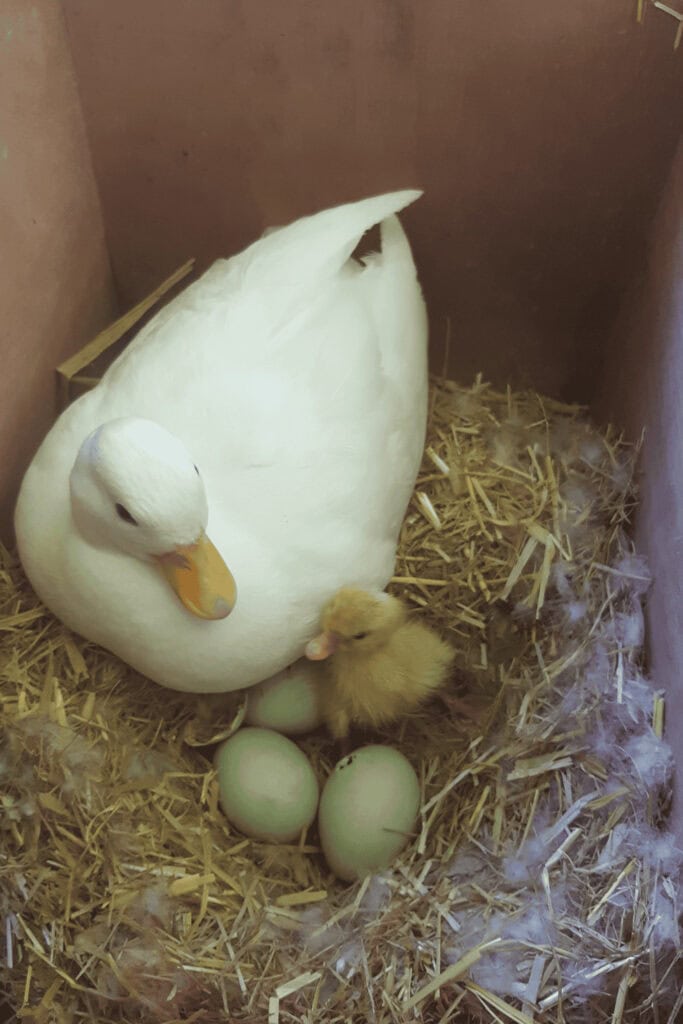
Duck eggs are noticeably larger than chicken eggs, with a thicker shell and a higher yolk-to-white ratio. The shells can range from white to pale blue, green, or even charcoal depending on the breed. Runners and Campbells typically lay white eggs. Muscovies lay cream-colored eggs. Shell color has no effect on flavor or nutrition.
Ducks almost always lay in the early morning hours, usually before 8 a.m. Collecting eggs daily, ideally each morning, prevents breakage and keeps nests clean.
Nutrition and When Ducks Start Laying Eggs
A duck approaching laying age needs feed that supports egg production, and that means switching from grower feed to a layer formulation at around 18 weeks. Layer feed for ducks should contain 16 to 17 percent protein and adequate calcium for shell formation. Chicken layer feed works in a pinch but is not ideal long-term because it lacks the niacin levels ducks require. Waterfowl-specific layer pellets are the better choice when available.
Calcium is the most important nutrient for consistent laying. Crushed oyster shell offered free-choice in a separate dish allows laying ducks to self-regulate their intake. Do not mix oyster shell directly into feed, as non-laying birds and drakes do not need supplemental calcium and too much over time causes kidney damage.
Adequate water access directly supports egg production. Ducks need water deep enough to submerge their bills to keep sinuses clear and support proper digestion of their feed. A duck that is dehydrated or has limited water access will drop in production quickly. For a laying flock, clean water available at all times is non-negotiable.
Why Ducks Stop Laying or Delay Starting
Several common situations cause ducks to delay first lay or stop laying after they have started. Understanding the causes makes troubleshooting faster.
Molting is the most predictable pause. Ducks lose and regrow feathers once or twice a year, and during a molt the body redirects energy away from egg production entirely. A molt typically lasts four to six weeks. Production resumes on its own once feathers are regrown.
Stress is a frequent culprit in young flocks. Predator pressure, flock changes, a move to a new pen, or the addition of new birds can all trigger a pause in laying. Ducks are more sensitive to disruption than chickens. Keeping the environment stable and minimizing sudden changes during the weeks around laying age helps the transition go smoothly.
Nutritional deficiency shows up as thin shells, soft eggs, or a complete halt in production. The most common deficiencies in backyard duck flocks are calcium, niacin, and overall protein. A diet audit and switch to proper layer feed resolves most nutritional laying problems within two to three weeks.
Broodiness in breeds like Muscovies and Rouens will pause egg production entirely. A broody duck sitting on a nest will not lay new eggs until her clutch hatches or is removed and she breaks from the broody cycle.
Setting Up Nesting Boxes Before Your Ducks Start Laying
Ducks do not require elaborate nesting setups, but having boxes ready before laying begins encourages them to lay in a designated spot rather than random corners of the pen, where eggs are harder to find and more likely to get dirty or broken.
A nesting box for ducks should be approximately 12 by 18 inches, low to the ground since ducks do not perch, and filled with clean straw or wood shavings. One box per three to four ducks is a reasonable ratio. Ducks are less inclined than chickens to fight over nest space, but having too few options can lead to crowding. Place boxes in a darker, more sheltered corner of the pen. Ducks prefer to lay in low-light areas. Our ducks never actually use nesting boxes. They just choose their own nest so we provide plenty of hay.
You do not need to lock ducks in overnight to collect morning eggs, but checking nest boxes each morning before allowing the flock out is a simple habit that keeps egg collection consistent and reduces losses. Laying age is only half the planning picture — it’s worth knowing how long ducks live before you size a flock. Guineas run on a different clock — see when guineas start laying eggs.
Frequently Asked Questions About When Ducks Start Laying Eggs
Do ducks lay eggs year-round?
High-production breeds like Khaki Campbells and Indian Runners can lay close to year-round with supplemental lighting to maintain 14 to 16 hours of light daily. Without supplemental light, most breeds slow significantly or stop during the short days of late fall and winter, resuming naturally in late winter or early spring as days lengthen.
Do ducks need a drake to lay eggs?
No. Ducks lay unfertilized eggs without a male present, just as chickens do. A drake is only needed if you want fertilized eggs for hatching. For a flock kept purely for egg production, drakes are optional.
How many eggs do ducks lay per week?
Production breeds like Khaki Campbells and Indian Runners lay 5 to 7 eggs per week at peak production. Pekins average 3 to 5 per week. Muscovies lay in clutches and may produce only 1 to 3 eggs per week during an active laying period, with breaks between clutches.
Why is my duck laying soft-shelled eggs?
Soft or thin shells almost always indicate a calcium deficiency. Offer crushed oyster shell free-choice in a separate dish alongside regular layer feed. If the problem persists after a week or two, check that the feed itself is a proper waterfowl or poultry layer formulation with adequate calcium content.
At what age do ducks stop laying eggs?
Most duck breeds begin declining in production by age 3 to 5, with Campbells and Runners typically tapering faster due to the high volume they produce in their prime years. Many ducks continue laying sporadically well into old age, but peak production years are generally the first two to three.