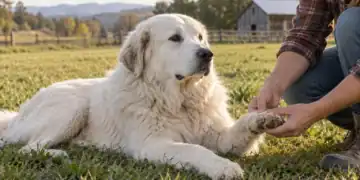

The Great Pyrenees is the livestock guardian dog many homesteaders meet first. It is big, white, gentle-looking, and famous for lying calmly near sheep, goats, chickens, and children. That picture is not wrong, but it is incomplete. A Great Pyrenees livestock guardian dog is still a working guardian with strong instincts, a loud bark, a serious roaming drive, and a long puppy stage that can test your patience.
For the right homestead, the Great Pyrenees is a wonderful choice. It is often calmer and more forgiving than some heavier-pressure guardian breeds. It can be especially useful for poultry and small ruminants when raised correctly. But a Pyr is not a magic predator shield. It needs fencing, time, training, shelter, and a job it understands.
If you are still deciding whether to buy a guardian at all, start with our guide to buying and caring for livestock guardians. Breed choice matters, but sourcing, setup, and expectations matter just as much.
What You’ll Learn

Why Homesteaders Choose Great Pyrenees
The Great Pyrenees was bred to guard flocks in mountain country, and that old job still shapes the breed. The American Kennel Club describes the Great Pyrenees as a large, thick-coated working dog originally bred to deter wolves and other predators. The AKC breed page is a useful outside reference for size, temperament, and general breed traits: Great Pyrenees breed information.
On a homestead, the breed’s biggest advantage is steady presence. A mature Pyr often works close to its animals, watches the boundary, and uses barking as a first line of defense. Most predators would rather avoid a large, confident dog. That is the point. A good guardian prevents many fights by convincing predators not to try.
Great Pyrenees are also known for being relatively gentle with smaller animals once mature. That does not mean a puppy is automatically safe with chickens. It means the adult instinct, if properly raised and supervised, often fits mixed homesteads well.

Temperament: Gentle Does Not Mean Passive
A Great Pyrenees can be sweet with family and still be firm with threats. That combination is exactly why people love them. Around their own animals and people, many Pyrs are patient, affectionate, and steady. Around strange dogs, coyotes, or unfamiliar movement at night, they become alert and vocal.
The barking is not a side effect. It is part of the job. A Pyrenees barks to announce itself, warn predators, and mark territory. If you live on acreage, that may be useful. If you live close to neighbors, it may become the reason the breed does not work for you.
Independence is another real trait. A Great Pyrenees may understand what you asked and still decide the fence line deserves attention first. That can frustrate owners who expect obedience-dog responsiveness. These dogs were bred to make decisions without a shepherd standing beside them. Train them, absolutely, but do not expect them to behave like a Border Collie.
Great Pyrenees With Chickens
Many people want a Great Pyrenees to protect chickens. It can be a good fit, but the poultry stage must be managed. Chickens flap, scatter, and make interesting sounds. A young guardian puppy can chase because it is immature, not because it is bad.
Use fencing and controlled exposure. Let the pup spend time near birds without being able to pounce on them. Reward calm lying, calm sniffing, and looking away. Interrupt stalking or chasing immediately. Do not laugh at rough play with birds when the dog is small, because it will not be funny when the dog is 90 pounds.
A mature Great Pyrenees can help deter raccoons, foxes, coyotes, and loose dogs, but it should not replace a locked coop. Chickens are most vulnerable at night, and a solid coop with small openings, buried wire where needed, and secure latches still matters.
Roaming and Fencing
Roaming is one of the biggest Great Pyrenees problems. The dog is not trying to run away. It is trying to patrol what it believes is its territory. Without a strong fence, that territory may keep growing.
Before bringing home a Pyr, walk your boundaries. Look for sagging wire, weak gates, holes under panels, and low spots where a large dog can push through. Many homesteads use woven wire with hot wire offsets or reinforced trouble spots. A GPS collar can help you locate a dog that slips out, but it is not containment. Our guide to the best GPS collars for farm dogs explains when cellular trackers work and when off-grid systems make more sense.
Grooming and Weather
The Great Pyrenees has a heavy double coat. That coat is part of why the breed handles cold well, but it also means shedding, mats, burrs, and heat management. During coat blow, expect hair everywhere. Brush regularly, check behind ears and around the tail, and watch for packed mats that hold moisture against the skin.
In winter, a healthy Pyr is usually comfortable in cold weather, but it still needs dry shelter, unfrozen water, and enough calories to maintain condition. In summer, shade and water matter more than people expect. A heavy-coated dog can overheat in humid conditions. Our guide to preparing livestock guardian dogs for winter covers cold-weather details for working guardians.
Training Timeline
Do not expect a Great Pyrenees puppy to be a finished guardian. Most LGDs mature slowly. The first year is about bonding, boundaries, calm exposure, and preventing bad habits. The second year is when many dogs become steadier and more useful.
Teach the basics: name recognition, recall, leash walking, gate manners, accepting touch, and calm behavior around livestock. Keep correction fair and immediate. Do not punish a puppy long after the mistake. Do not leave a bored adolescent alone with fragile animals and hope instinct solves everything.
The best guardian dog training is boring in the best way: same rules every day, same calm expectations, same quick interruption when the dog starts to chase or roughhouse. Over time, the dog learns that livestock are family, not toys.
Is a Great Pyrenees Right for Your Homestead?
Choose a Great Pyrenees if you need a close-working guardian, have secure fencing, can tolerate barking, and want a breed often suited to poultry, goats, and sheep. It is a strong first LGD choice for many homesteaders because it is widely available and generally more forgiving than some intense guardian breeds.
Skip the breed if you have close neighbors, weak fencing, no time for puppy supervision, or cannot manage the shedding and barking. A Great Pyrenees is a working partner, not a plug-in predator solution. Raised well, it can be the dog that lets you sleep better when the coyotes start up beyond the pasture.
Frequently Asked Questions About Great Pyrenees as a Livestock Guardian Dog
Are Great Pyrenees good livestock guardian dogs?
Yes. Great Pyrenees are one of the most common livestock guardian dogs for small farms and homesteads, especially with sheep, goats, and poultry.
Are Great Pyrenees good with chickens?
Many are good with chickens once mature and properly raised. Puppies still need supervision and correction for chasing or rough play.
Do Great Pyrenees bark all night?
They often bark at night because many predators move after dark. That barking is normal guardian behavior, but it can be hard near neighbors.
Do Great Pyrenees need a fence?
Yes. A Great Pyrenees needs secure fencing because the breed has a strong instinct to patrol and expand territory.