
A frozen barn line usually reveals itself at the worst time: no water at the hydrant, animals waiting, and a forecast that promises another night below freezing. To prevent frozen pipes in barns and outbuildings, trace the whole route before the cold arrives, then decide which branches will stay active and which can be shut off and drained.
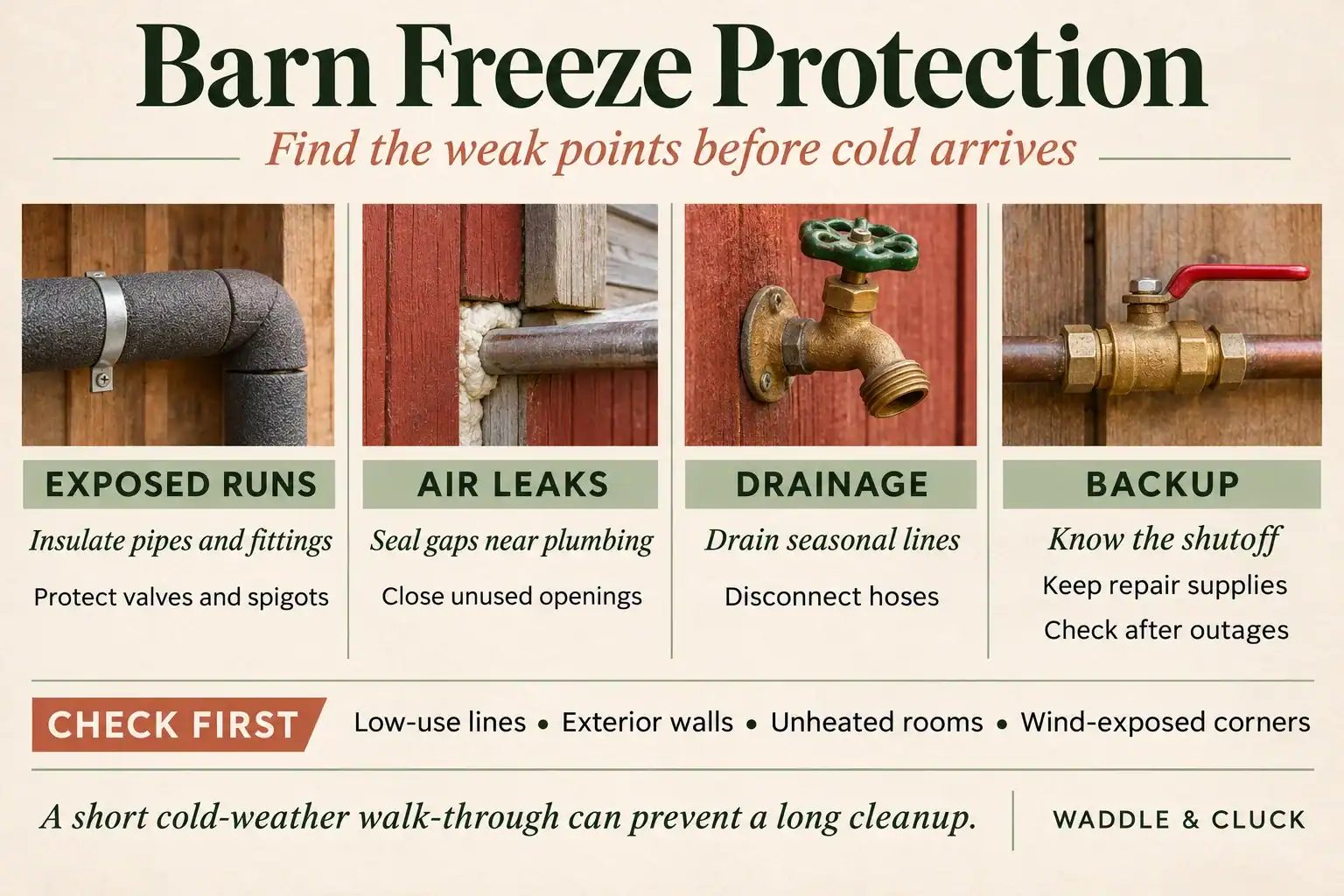
Insulation helps a pipe hold heat it already has. It does not create heat. Active lines need protection at valves, wall penetrations, crawl spaces, hydrants, and other exposed points, while seasonal lines need a reliable way to empty completely.
The best winter plan also includes stored backup water and a clear shutoff location, because prevention sometimes fails despite careful preparation.
Start where the barn supply branches from the house or well system. Find the valve that isolates that branch and the drain points intended for winterizing it. Our homestead plumbing basics guide covers the wider shutoff-and-repair checks; this walk-through focuses on the route serving an outbuilding.
Make a small sketch rather than relying on memory. Mark which fixtures share a branch, especially if a workshop sink and livestock waterer use the same supply. Closing the wrong valve could leave animals without water while another line remains exposed.
Walk the accessible route with a flashlight and check these places:
- The point where the pipe enters the building, including gaps that let cold air reach it.
- Exposed elbows, valves and short upright sections between insulated runs.
- Faucets, hose connections and any equipment that holds water beyond the shutoff.
- Insulation that is missing, wet, loose or damaged, and plumbing within animal reach.
- The path to the isolation valve and drain, which must remain reachable after winter storage or snow arrives.
A corroded, leaking or stuck valve needs attention before you depend on it. Do not force it. Ask a plumber to identify an unknown shutoff or drain, and leave well caps, electrical controls and pressure equipment closed.
Mark concealed stretches on the sketch. Ask the installer how each hidden run is protected and whether it can be drained. You need that answer before treating the branch as ready for winter.
Drain the branches that can stay off
An unused wash sink or seasonal garden connection may not need an active water supply until spring. If its branch can be isolated without interrupting essential water, proper drain-down removes the water that would otherwise need protection.
Follow the installer or equipment manufacturer’s shutoff and draining sequence. Closing a valve stops incoming water, but it does not prove that the pipe beyond it is empty. Low spots, fittings and attached devices may retain water even when an open faucet has stopped flowing.
Disconnect hoses, drain them and put them away. Iowa State Extension’s freeze-prevention guidance explains that a connected hose can trap water even in a faucet designed to resist freezing. The page is archived, so use it for these basic mechanisms alongside your fixture’s current instructions.
If you cannot identify how a branch empties, have a plumber check it rather than guessing which fitting to loosen. Do not improvise with compressed air or add antifreeze to a water supply. Pumps, pressure tanks and other equipment need their own specified winterization procedures, beyond opening a barn faucet.
Keep a note of which lines are off and what condition each fixture should remain in. Anyone helping with chores should know that a winterized branch is unavailable, so they do not turn it back on during a cold spell.
Check whether a frost-free hydrant can drain
A frost-free yard hydrant relies on more than its aboveground handle. In the design described by British Columbia’s winter livestock-water guidance, the handle operates a valve below the frost level. When closed, the hydrant lets water drain out of the upright riser.
That mechanism depends on the installation and drainage working as intended. An attached hose can interfere with draining, so disconnect it after use as the fixture instructions require. The words frost-free on a handle cannot tell you whether an underground drain works or the installation suits local conditions.
A hydrant that repeatedly freezes, no longer drains as expected or develops unexplained leakage deserves an installer or plumber’s inspection. Avoid dismantling it in frozen weather. Ask about the model’s operating instructions, local frost depth and drainage, including the backflow and contamination protections appropriate to your water supply.
There is no single burial-depth number that makes every property safe. Soil, climate and the installed system matter, and a generic diagram cannot replace a local assessment. Treat a partly open hydrant as an operating question for its manufacturer, not a standard winter setting.
Prevent frozen pipes in barns without relying on insulation alone
Daily water use means keeping the supply working through cold weather. Inspect its entire exposed route before choosing insulation or heat. A short bare valve or building entrance can remain vulnerable after the rest looks finished. Protect insulation from moisture and damage, including chewing or rubbing where animals can reach it.
Address drafts around utility-pipe penetrations without closing the ventilation animals need. If plumbing runs through an especially exposed corner, ask whether rerouting it or placing it in a properly designed protected enclosure would be more dependable. Sealing the whole barn to keep one pipe warmer creates a different housing problem.
Insulation buys resistance to heat loss, not a permanent supply of warmth. In prolonged cold, an unheated pipe with standing water may still freeze. The amount of protection depends on the conditions; there is no honest universal promise of a certain number of safe hours.
Keep the incoming line and drinking vessel separate on your inspection sheet. Protecting a bowl does not protect its supply, and protecting the supply does not keep every bowl unfrozen. The British Columbia guidance calls for drainage provisions for both above-frost supply piping and the waterer when the system does not drain itself.
Heating cable needs a suitable pipe and electrical supply
Listed pipe-heating equipment must suit the pipe material and the location where it will operate. Do not assume roof deicing cable is suitable for a water pipe. Read the exact product instructions before deciding how to attach it or cover it.
The manufacturer’s directions govern routing, attachment, thermostat placement and insulation. Iowa State specifically warns against overlapping heating tape or using it over or under insulation unless the manufacturer permits that arrangement. A self-regulating label does not establish that every overlap or covering is allowed.
Ask a qualified electrician to assess the supply and appropriate ground-fault circuit-interrupter protection, often called GFCI protection. It adds electrical safety, but it does not make damaged wiring or unsuitable equipment safe. Animal access, moisture and physical damage all belong in that assessment.
An extension cord stretched across the barn is not permanent winter wiring. The Consumer Product Safety Commission’s extension-cord safety advice limits cords to temporary use and warns against running them through doorways. Damaged cords need replacement; outdoor use requires outdoor-marked cords, subject to the heating product’s own instructions.
Keep heat lamps, loose portable heaters and open flames away from hay, bedding, dust and combustible storage. Do not solve a freezing problem by introducing one of those heat sources beside the plumbing. If a pump house needs heat, have a qualified professional assess a protected enclosure and suitable equipment rather than improvising a heater arrangement.
Buried lines can still freeze
A buried supply still needs scrutiny where it rises into the barn. Recent trench work, unsettled backfill or changes to the ground above a line can also alter its cold exposure. Tell a plumber about excavation or removed soil along a route that previously worked through winter.
Iowa State notes that a buried line’s risk period can extend beyond the extreme cold while heat returns through the ground. A mild afternoon does not prove the underground supply has recovered. Recurring freezes call for investigation of cover and routing, not an annual thawing routine or a pile of hay over an unknown problem.
Dripping needs a reliable supply and safe drainage
Letting a faucet drip is a conditional measure. Replacement water can carry heat, but continuous flow requires an adequate supply and somewhere safe for the discharge to go. A barn aisle, gate approach or livestock path that becomes icy is a poor drainage destination.
Before relying on flow, discuss the arrangement with a plumbing or well professional and follow local guidance. Consider water use and well recovery, along with what happens if electricity stops the pump. Do not leave an unattended faucet running as a substitute for a winterization plan.
A trickle calls for a careful check
Little or no flow during cold weather can suggest freezing, although a supply or well problem can look similar. Compare safely accessible fixtures and locate the branch shutoff without forcing valves. Do not open electrical or pressure controls to chase the cause.
If a pipe leaks or appears damaged, isolate the water if you can do so safely and call a plumber. Stay out of areas where water meets electrical equipment; do not wade in or handle wet plugs. Getting water restored is less urgent than avoiding a shock.
For an intact, accessible suspected freeze with no electrical hazard, the Red Cross frozen-pipe guidance recommends keeping the faucet open while applying gentle warmth. Warm wet towels are one option for that limited situation. Stay with the work and stop if leakage appears.
Never use a torch, open flame or combustion heater to thaw the line. Avoid boiling-water shocks, power-welder thawing and unattended heaters. Call a licensed plumber when you cannot find the freeze, cannot reach it safely or cannot restore flow; concealed and buried freezes are not a reason to start digging or applying heat blindly.
When water returns, inspect accessible pipe and connections for leaks and confirm normal flow. A thawed line may still be damaged. Recheck it rather than assuming the first running faucet means the job is finished.
Put backup water on the chore sheet
Heating cable needs electricity. A well pump may need the same electricity, and remote alerts may need both power and a working connection. One outage can interrupt several protections at once.
Our guide to monitoring well water levels addresses source-water awareness, a separate task from pipe protection. A well-level sensor does not detect or prevent a frozen barn pipe. Someone still needs to check flow at the point of use.
Arrange an accessible alternate safe water supply and a way to carry it before the regular line fails. Decide who will check water during cold spells and after outages, including when you are away. Include the supply route and drinking vessels in those checks, not only whether a heater has power.
Watch where water lands during filling, hose draining and bucket carrying. Spills can wet bedding or freeze across the approach to shelter. Our winter livestock care guide connects those chores with shelter and footing; the seasonal homesteading guides can help organize the surrounding work.
Leave your labeled water-route sketch where a chore helper can find it, with the plumber’s contact information and backup-water location. Walk that helper to the shutoff before freezing weather, while the path is clear, and show them where to get backup water.
Walk the water route once with a roll of bright tape and mark every valve, wall penetration, low point, and exposed fitting. Which section would be hardest to drain in the dark?
Frequently Asked Questions About How to Prevent Frozen Pipes in Barns and Outbuildings
Does pipe insulation prevent freezing by itself?
No. Insulation slows heat transfer but does not generate heat. In prolonged cold, an inactive or exposed line can still freeze unless it is drained, buried appropriately, or protected by a suitable heat source.
Should I let a barn faucet drip?
A drip can sometimes reduce freezing risk, but it depends on a dependable supply and safe drainage. It can create ice, waste water, overwhelm a drain, or fail during a power outage.
Why does a frost free hydrant freeze?
It can freeze when the standpipe cannot drain below the frost line, the drain area is saturated or compacted, the handle is not fully closed, or a hose remains attached.
What should I do if a barn pipe is frozen?
Shut off water if damage is possible and contact a qualified plumber. Avoid open flames and improvised heating. A split may not leak visibly until the line thaws.