
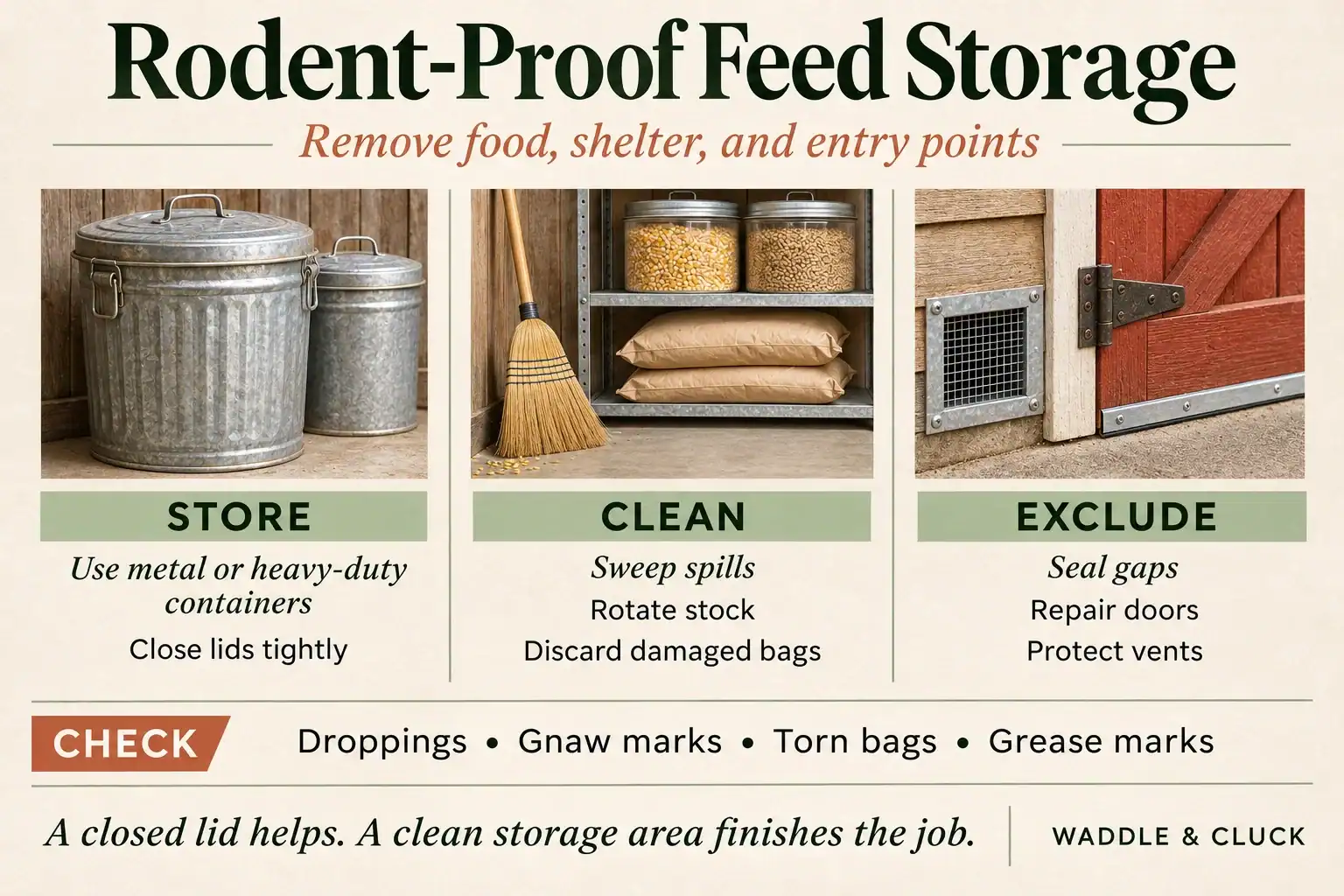
A feed room can look tidy at standing height and still offer mice everything they need. A few kernels under a pallet, a loose lid, and a gap beside the door are enough to turn an occasional visitor into an established problem. Rodent-proof livestock feed storage begins with the container, but it succeeds or fails in the space around it.
Use chew resistant bins with lids that close fully, keep bags and containers off damp floors, and clean spills beyond the obvious scoop area. Then inspect the room at mouse height. Follow walls, corners, pipes, doors, and floor edges where small openings are easy to miss.
The goal is to protect feed quality, reduce waste, and make new activity obvious before contamination spreads through the storage area.
A feed-suitable metal can with a well-fitting lid is a sensible starting point for bagged dry feed. Nebraska Extension’s rodent-proof construction guide recommends secure, tight-lidded containers for livestock feed. Its storage illustration uses metal containers; the practical lesson is to check the whole container, including its closure.
Run through the parts that can fail before filling it. Does the lid sit evenly around the rim? Are there openings at seams or fastenings? Inspect the bottom for holes, rust or damage, and reject a container that cannot close properly.
An airtight plastic bucket may keep moisture out while remaining vulnerable to chewing. UC IPM’s house-mouse guidance documents mice gnawing storage containers and identifies plastic among gnawable materials. Airtight, weatherproof and chew-resistant describe different properties; one label does not establish the others.
Choose a container intended for feed contact or confirm suitability with its manufacturer.
Pass over old chemical drums and barrels with unknown previous contents. A clean appearance cannot establish what was stored in them.
Consider how the lid works during chores, too. A closure that is awkward to replace is more likely to stay off while you carry buckets. If your existing bin is sound, suitable and closes securely, inspect the rest of the feed system before assuming a new purchase will solve the problem.
Dry storage still needs labels and rotation
MSU Extension’s feed handling and storage guidance calls for a dry, covered location and storage off the ground on pallets or shelves. Feed can draw moisture from concrete as well as soil.
Use stable supports appropriate for the load and leave room to inspect behind and beneath stored feed. Check for roof leaks, plumbing drips and weather entering at doors.
Mice climb. A pallet helps keep feed away from floor moisture, but the bag on top still needs protection from chewing.
Keep the original labeled bag inside a suitable container when practical. If you empty feed into a bin, label the bin and retain the bag’s tag, lot information and date for reference. Record the exact feed, intended species and life stage, plus medication information when applicable; pellet shape is not a reliable label.
MSU stresses labeling when different species or ages of animals share a storage area, along with following feed-label directions. Keep feeds separate rather than combining them to save a container. Someone helping with chores should be able to identify the contents without guessing.
Use older suitable stock before opening newer feed, and empty and inspect residues rather than continually pouring fresh feed over the old layer. Storage life varies with the feed and its handling. Follow the maker’s directions and ask the supplier if you are unsure; there is no single safe storage period for every livestock feed.
We use these 55 gallon steel drums with the lid closure. We don’t have any problems.

Follow the spills past the storage bin
A tidy row of cans can hide a messy feeding route. Torn sack seams, scoop dribbles and feed beneath a hopper all deserve attention. Inspect the floor edges and bedding under feeders, not only the clear walking space.
Check incoming bags before putting them away, too. A torn or gnawed sack belongs in the inspection rather than disappearing behind newer stock. If the damage suggests rodents have reached the contents, keep that feed out of animal use while you assess it.
Ordinary, uncontaminated spills should be removed promptly. MSU identifies spilled feed as an attractant for rodents and other pests. If you see droppings, nesting material or suspected urine contamination, stop treating the mess as an ordinary spill and use the precautions below instead of sweeping it.
At poultry feeders, work out what is falling before changing equipment. Dry feed raked over the rim points you toward fill depth, opening design or feeder height. Damp clumps beneath the same feeder call for a waterer and placement check as well.
Our guide to reducing feed waste in quail feeders separates those causes and recommends changing one factor at a time. Watch the birds after an adjustment, including the smaller ones. They still need comfortable access to feed.
Feeder placement also affects whether the feed stays dry. In our OverEZ chicken feeder review, sheltered placement is a stated limitation even for equipment described as weather-resistant. That review is useful for thinking about design and location, not evidence that the feeder excludes rodents.
A low-waste feeder still has an opening animals eat through. Check it separately from the closed storage bin, and do not impose one overnight feed-removal rule across every species and life stage. The wider livestock and poultry care guides can help you keep equipment decisions tied to the animals using it.
Inspect the barn at mouse scale
Mice can enter through openings as small as a quarter inch, according to UC IPM’s house-mouse exclusion guidance. Half-inch mesh used elsewhere in a poultry enclosure should not be assumed to exclude mice. A barrier that stops a larger animal can still leave a usable opening.
Walk the feed-room perimeter with a light. Examine the door threshold, the center seam of paired doors and the wall-to-floor joint. Check around pipes and cables, then look for damaged vent edges and roof or eave openings from a safe position.
Rodents can reach openings above the floor, including gaps beside pipes entering higher up a wall. Include those routes in the inspection rather than stopping once the threshold looks sound. Outside, move stored clutter away from inspection points so you can see the foundation and the places where siding meets the ground.
Durable repairs can use metal, concrete or appropriately secured metal screening or hardware cloth, depending on the opening. Fastening and edge fit matter along with hole size. A loose corner leaves access even when the screening itself is suitable.
Expanding foam, plastic screening, rubber and wood alone can be gnawed. UC describes steel wool as a temporary plug that may rust, rather than a permanent repair. Check what the repair is attached to; covering a damaged edge without securing it to sound material leaves another weak point.
Preserve ventilation and drainage when screening openings. Vents need a system-appropriate repair that maintains airflow, not a universal mesh prescription. Bring in the appropriate professional for electrical lines, powered augers, utility penetrations or structural and drainage-system work; do not improvise guards around live equipment.
A feed-room door left open between chores gives rodents access around repaired gaps. Close it when access is not needed. Recheck the threshold after repairs so the door still opens and closes properly.
If rodents have reached the feed
Feed containing rodent droppings is unsafe for animal use. UC IPM identifies fecal contamination as a reason stored food becomes unsafe. Isolate affected feed, prevent animal access and inspect nearby bags and bins for damage or contamination.
Do not sift out droppings, mix suspect feed with clean feed, wash it or spray it with disinfectant. Feeding it to a different species does not resolve the contamination. Arrange disposal under appropriate local guidance, keeping waste inaccessible to animals, and contact your feed supplier or veterinarian if animals may have eaten affected feed.
A new lid cannot rescue damp, moldy or contaminated feed. Nor can clean-looking pellets on top establish that the contents below are safe. Keep suspect material out of use while you obtain advice about the affected batch.
Rodent-waste cleanup needs different handling from a clean feed spill. Washington Department of Health’s guidance for cleaning up after rodents says not to vacuum, sweep or stir up contaminated dust. Its precautions include these steps:
1. Air out enclosed areas for at least 30 minutes by opening doors and windows, and leave during airing. 2. Wear rubber gloves. Wet contaminated waste and surfaces with an appropriate disinfectant, following its label for dilution and disinfection time. Keep cleaning chemicals off feed and away from animals. 3. Wipe up the material and double-bag the waste for appropriate disposal. Wash or disinfect gloves before removing them, then wash your hands.
Follow current local public-health advice for the setting, especially if contamination is extensive. Heavy accumulations or contaminated ventilation call for professional assessment and cleanup. Washington DOH warns that a dust mask does not protect against viruses; get professional advice about protection for heavy contamination.
Clean reusable containers and storage surfaces with methods and products suitable for those surfaces. Follow any feed-contact rinsing directions and let containers dry before returning feed. Disinfection is for appropriate equipment and surfaces, never a way to salvage feed.
Continued activity needs more than a better lid
Sanitation and exclusion reduce food, shelter and access, but rodents already inside may still need population control. UC IPM’s rat-management guidance treats these as complementary measures. Closing entry points does not remove an established population by itself.
Protected traps may be part of the response. Use devices appropriate for the target rodent and follow their instructions, with boxes, stations or barriers that keep livestock, poultry, pets, wildlife and children away from triggers. Repeated activity, inaccessible nesting areas or uncertainty about safe placement are reasons to seek qualified help.
Never put loose poison in a feed bin or scatter bait around stored feed. EPA’s rodent-bait safety guidance requires following product labels and keeping pesticides separate from food. A station does not make every bait suitable for every livestock building; the labeled site and placement restrictions still control its use.
Rodenticides can poison non-target animals directly, and some can harm animals that eat poisoned rodents. A barn cat does not remove those risks or replace sanitation and exclusion. UC also finds little evidence that ultrasonic devices drive established mice or rats out of buildings.
Leave a record for the next feed round
Make the short checks part of regular feed chores: replace lids, remove ordinary spills and look for fresh damage. Periodically inspect the hidden edges behind bins and under supports, along with the outside openings. Give repaired areas another look after deliveries or work that changes the room.
Record the date, exact location, evidence found and action taken, then set a follow-up. Distinguish new damage from an old mark without treating a clean inspection as proof that suspect feed is safe. Notes and photos are useful if the same corner needs professional attention later.
Our homestead pest inspection checklist extends the same recordkeeping to the rest of the property. On your next feed round, check beneath the feeder as well as inside the storage room. Record what you find and when you will look again.
After the next feeding, turn off the overhead light and inspect the room with a flashlight held near the floor. Where could grain collect or a mouse move unseen?
Frequently Asked Questions About Rodent-Proof Livestock Feed Storage: Containers, Spills, and Barn Exclusion
Can mice chew through plastic feed bins?
Mice can damage many plastics, especially thin totes or containers with exposed edges. Heavy, food safe containers may work in some settings, but metal bins with tight fitting lids offer stronger chew resistance.
Are metal trash cans safe for livestock feed?
A clean metal can with a secure lid can be practical when it is kept dry and used only for feed. Check seams, handles, and lid fit, and confirm that the container is appropriate for the feed and storage environment.
What should I do if mice get into livestock feed?
Stop using visibly contaminated or wet feed and contact the feed manufacturer, veterinarian, or Extension professional for species specific guidance. Clean the area safely and correct both the container problem and the entry route.
How small a hole can a mouse enter?
Mice can use surprisingly small openings. Inspect gaps around doors, pipes, siding, corners, and the roofline, then choose exclusion materials appropriate to the building rather than relying on foam alone.