Small hive beetle infestations are one of the fastest ways to lose a hive you have worked hard to build. These small, fast-moving pests tunnel through comb, ferment your honey, and can reduce a productive colony to a slimed-out wreck within weeks if populations get out of hand. Backyard beekeepers in the Southeast face them every season, and their range is spreading north and west. Knowing what to look for and how to respond is one of the most practical skills you can develop as a beekeeper.
Key Takeaways
What Is a Small Hive Beetle?
Small hive beetles are dark brown to black, oval-shaped insects about five to seven mm long. They are native to sub-Saharan Africa and arrived in the United States around 1998, first identified in Florida. They are now established throughout the Southeast and Gulf Coast states, with populations documented as far north as Michigan and as far west as California.
Adults are fast-moving and photophobic, meaning they avoid light. When you open a hive with a beetle problem, you will see them scatter across the frames toward dark corners and crevices the moment light hits them. Bees will chase them, but a healthy colony can only do so much. The beetles are small enough to wedge themselves into spaces bees cannot follow.
The lifecycle moves quickly in warm weather. A female beetle can lay up to 1,000 eggs in her lifetime, depositing them in crevices, under debris, or directly in comb. Eggs hatch within two to three days. Larvae feed for 10 to 16 days before dropping to the soil beneath the hive to pupate. Adults emerge in three to four weeks and immediately seek out a hive. In a warm Southern summer, multiple generations can cycle through in a single season.
How to Identify a Small Hive Beetle Infestation
The adults are your first visual clue. Open the hive and watch what moves. Beetles scatter toward the bottom board, the corners of boxes, and the underside of the cover within seconds of exposure to light. Check those spots specifically: the bottom board, the inner cover, any gap or crack in the woodware. If you see small, oval, dark insects running away from you, you have beetles.
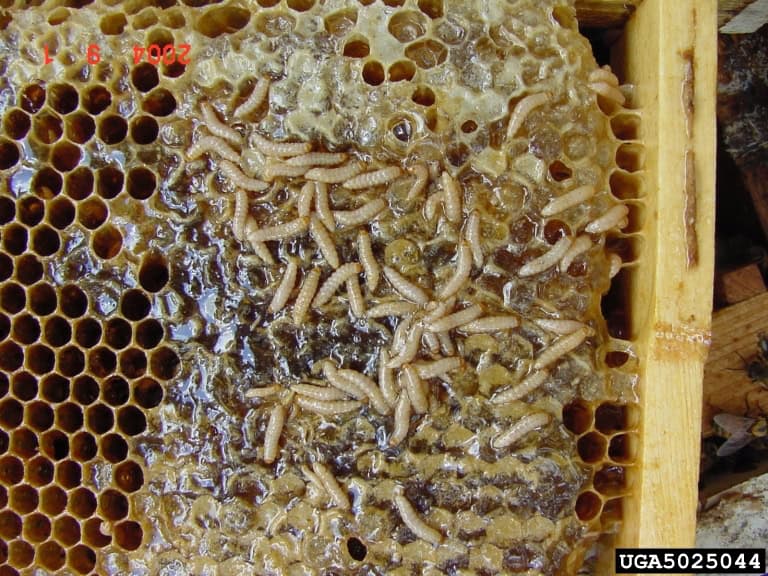
Larvae are harder to spot at first but unmistakable once you know what you are looking for. They are cream-colored, about 10 mm when fully grown, with rows of tiny spines along the back and three pairs of legs near the head. You will find them tunneling through comb, leaving behind trails of destruction and a characteristic smell.
That smell is the clearest sign that beetles have moved beyond a manageable population. Infested honey ferments and takes on a strong odor of rotting citrus or fermenting fruit. If any section of your hive smells like that when you open it, larvae have already been at work there and the comb in that area is likely unsalvageable.
Why Small Hive Beetles Are So Destructive
The adult beetles are a nuisance the bees can largely manage on their own. The larvae are the problem. As they tunnel through comb, they consume honey, pollen, and brood indiscriminately. More damaging is what they leave behind: a yeast called Kodamaea ohmeri that they introduce into the honey as they feed. This yeast triggers rapid fermentation, turning honey slimy, discolored, and completely inedible.
Once fermentation starts in a section of comb, bees will often abandon it rather than clean it out. In a severe infestation, bees may abandon large portions of the hive, or leave the hive entirely in a process beekeepers call absconding. A colony that absconds because of small hive beetles rarely survives.
The damage accelerates in hot weather. Beetles reproduce faster, larvae develop faster, and fermentation spreads more quickly through warm honey. Late summer, when hives are often at peak honey stores and dearth conditions may be stressing the colony, is the highest-risk period of the year.
What Makes a Hive Vulnerable to Small Hive Beetles
A strong colony with a solid population can police a moderate beetle presence on its own. Bees will chase, catch, and entomb beetles using propolis, sealing them off in corners where they cannot reproduce. The tipping point comes when the bee-to-beetle ratio shifts in the beetles’ favor.
Several conditions create vulnerability:
- A colony that has lost population through swarming, disease, or a failing queen
- A hive body with more space than the bee population can cover and guard
- Hot weather combined with a summer dearth, when bees are clustered loosely and less active
- A hive situated over loose, sandy soil, which provides ideal pupation conditions for larvae
Understanding what creates vulnerability is the foundation of small hive beetle treatment. You are not just trying to kill beetles. You are trying to keep conditions unfavorable for them to establish.
How to Get Rid of Small Hive Beetles
Keep Your Colony Strong
The single most effective small hive beetle treatment is a populous colony. A hive with eight or more well-covered frames of bees can run down and entomb beetles faster than they can reproduce. When a colony thins out, combine it with a stronger hive rather than letting it struggle through summer. Two medium colonies are harder to manage than one strong one, and a weak colony is an open invitation for beetles to take hold.
Reduce Unoccupied Space
Beetles breed in dark, unguarded space. If your hive has more room than the bee population can cover, you are giving beetles exactly what they need. Remove empty supers when they are not being actively worked. Use a follower board to reduce the interior volume proportionally to the bee population. As the colony grows back, you can expand the space again.
Use Beetle Traps
Traps are a practical and low-cost supplement to strong colony management. The most widely used designs work on the same principle: a reservoir of food-grade mineral oil or vegetable oil positioned where beetles travel, into which they fall and drown.
22 x Beetle blaster
Made of Plastic, sturdy and reliable
Size: 9.06 x 1.57 x 1.5 inches/ 23 x 4 x 3.8 cm

Replace the oil in frame traps every two to three weeks through summer. A trap that has dried out is not doing anything.
Disrupt the Soil Lifecycle
Beetle larvae drop to the soil beneath the hive to pupate. If your hives sit on bare ground, particularly loose or sandy soil, you are providing ideal conditions for that stage of the lifecycle. Placing hives on concrete pavers or hardware cloth disrupts pupation. Ranging chickens near the hive yard will scratch up and eat larvae and pupating beetles in the soil, which is genuinely effective and costs nothing if you already keep chickens.
What About Chemical Treatments?
Chemical options for small hive beetle treatment are limited and come with significant restrictions. Coumaphos-based products exist but are not recommended for routine management in backyard apiaries. The risks to brood and honey stores generally outweigh the benefits when physical management methods are working. If you are keeping a strong colony, managing hive space, and using traps consistently, chemical treatment should not be necessary.
How to Check for Small Hive Beetles During Routine Inspections
Build beetle monitoring into every hive inspection rather than treating it as a separate task. When you open the hive, give yourself five seconds to watch what moves before you start pulling frames. Note how many beetles you see and where they are concentrated.
Check the bottom board every time. Slide it out if you have a screened bottom board, or look beneath the lowest box. The bottom board accumulates debris, wax scales, and dead bees, all of which provide cover for beetles. A heavy beetle presence on the bottom board while the brood boxes look clean tells you the population is there but controlled. A heavy presence on the frames themselves tells you control is slipping.
Trust your nose. A hive that smells like fermented citrus when you crack the lid has a problem that has already progressed beyond early stages.
Small Hive Beetles and Varroa Mites: A Compounding Problem
High mite loads and small hive beetle pressure frequently arrive at the same time in late summer. This is not a coincidence. A colony dealing with elevated varroa levels is already weakened, with a declining population and compromised individual bees. That weakened state reduces the colony’s ability to defend against beetles simultaneously.
If an inspection reveals both elevated mite counts and increasing beetle activity, address both in the same visit. Install beetle traps and begin varroa mite treatment before you close the hive. A colony fighting two threats at once needs help on both fronts, not a staged response.
According to the University of Florida IFAS Extension, small hive beetle management is most successful when focused on maintaining strong colonies and removing conditions that favor beetle reproduction, which aligns with what experienced beekeepers have found in practice.
Keeping Small Hive Beetles in Perspective
Small hive beetles are a real threat, but they are a manageable one. A strong colony with adequate population, properly sized hive space, and basic trapping in place can keep beetle populations well below the level where damage occurs. The beekeepers who lose hives to beetles are almost always dealing with a colony that was already compromised for another reason.
Monitor every time you open the hive. Keep your colonies strong. Reduce space when population drops. Install traps through summer. Those four habits will handle small hive beetles in the vast majority of backyard beekeeping situations.
For more on keeping your colony healthy through the season, see our guide to maintaining a healthy beehive.
Can small hive beetles kill a hive?
Yes. A severe infestation can collapse a colony within weeks. Larvae tunnel through comb, ferment honey, and cause bees to abandon infested sections. Strong colonies manage low beetle populations on their own, but a weakened hive can be lost quickly if the problem goes unaddressed.
What kills small hive beetles?
Food-grade mineral oil in frame traps drowns adult beetles effectively. Strong colonies will chase and entomb beetles using propolis. For larvae already in the soil beneath the hive, disrupting the ground with hardware cloth or ranging chickens nearby reduces pupation success.
How do I know if small hive beetles are out of control?
The clearest sign is smell. If your hive smells like fermented citrus when you open it, larvae are actively working through comb and the infestation has progressed beyond early stages. Visible larvae in the comb and bees clustering away from sections of the hive are also reliable indicators.
Do small hive beetles affect honey production?
Yes. Beetles and their larvae contaminate honey stores, making them unsalvageable. Fermented honey cannot be harvested or fed back to bees. A colony managing a heavy beetle load is also diverting energy from foraging and brood rearing to beetle patrol, which reduces overall productivity.
Are small hive beetles a problem in northern states?
Historically they were considered a Southern pest, but their range has expanded significantly. Populations have been documented as far north as Michigan and into parts of the Midwest and mid-Atlantic. Beekeepers in any state with warm summers should monitor for them.