
Calving is the event new cattle owners dread most, and mostly it goes fine. The overwhelming majority of cows calve unassisted, at an inconvenient hour, without anyone noticing until there is a wet calf standing in the pasture. The reason to prepare carefully is not that trouble is likely. It is that when trouble happens it moves fast, and the window between “this is taking a while” and “this calf is in real danger” is measured in tens of minutes.
This article covers the event itself: what to have ready, what normal looks like at each stage, and the specific thresholds for picking up the phone. For the calendar side, how long she is pregnant and when to expect her, see our guide to how long a cow is pregnant.
Key Takeaways
The Calving Kit: What to Have Ready
Assemble this weeks ahead and keep it in one container somewhere you can reach in the dark.
For you: obstetric gloves (shoulder length), plenty of clean towels, a strong flashlight or headlamp with fresh batteries, obstetric lubricant in quantity, disinfectant, and a bucket.
For assistance: two obstetric chains or straps with handles. Use chains or straps rather than rope, since rope concentrates pressure and damages the calf’s legs. A calf jack is worth owning if you have any distance to a vet, but only if you have been shown how to use one, because a calf jack in untrained hands does far more damage than no jack at all.
For the calf: navel dip (7 percent iodine or chlorhexidine), a clean towel for drying, and a bottle with a calf nipple plus a bag of powdered colostrum replacer. The replacer is the item people skip and regret, because the moment you need it is the moment you cannot buy it.
Written down and visible: your vet’s number and after-hours number, the cow’s identification and due date, and the phone number of whichever neighbor would come help at 3 a.m. Calving assistance is often a two-person job and the second person is easier to find before you need them.
Where She Should Calve
The default answer on a homestead is a clean, well-drained pasture in good weather, and a bedded pen in bad weather or hard cold.
The priorities are cleanliness, footing, and your ability to see her. A muddy pen is a scours risk for the newborn. Slick footing is a real hazard for a cow going down and getting up. And a cow calving somewhere you cannot see or reach with a vehicle is a problem you have created for yourself.
Move her to the calving area well before she needs it, ideally a week or two out. Moving a cow in active labor interrupts the process and adds stress at exactly the wrong moment.
Signs Calving Is Close
Over the final weeks, her udder fills and tightens, which is often the first clear sign. In the last day or two the ligaments either side of her tailhead soften and sink noticeably, giving the hindquarters a hollowed look. Vulvar swelling and relaxation increase. Some cows show a thick mucus discharge in the final day.
Behaviorally, most cows separate themselves from the herd and go looking for somewhere private. She may go off feed. She may lie down and stand repeatedly, swish her tail, kick at her belly, or look round at her flank.
None of these signs are reliable enough to predict the hour. Plenty of cows show every sign and then wait three days. Use them to increase your checking frequency, not to plan your night.
The Three Stages of Calving
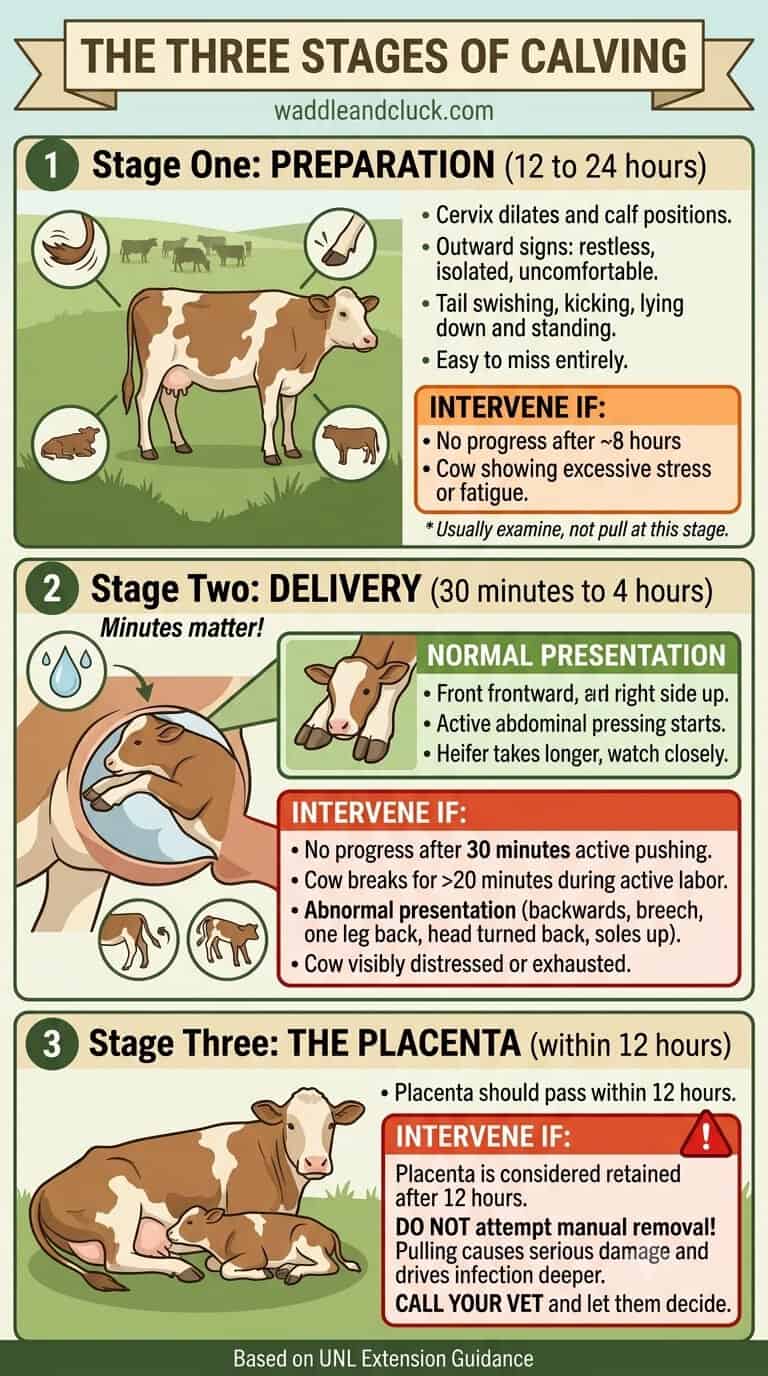
The University of Nebraska-Lincoln Extension’s calving guidance sets out the stages and the intervention points clearly, and these figures are the ones worth committing to memory.
Stage One: Preparation, 12 to 24 hours
The cervix dilates and the calf positions itself. Outwardly this is the restless, isolated, uncomfortable phase: tail swishing, kicking, lying down and standing, separating from the herd. It does not look like dramatic labor and it is easy to miss entirely.
Intervene if there has been no progress after about 8 hours, or if the cow is showing excessive stress or fatigue. Intervening at this stage usually means a closer examination rather than pulling a calf.
Stage Two: Delivery, 30 minutes to 4 hours
This begins when the water breaks and active abdominal pressing starts. In a normal presentation you will see two front feet, soles down, followed by the nose resting on the legs. The calf comes frontward and right side up.
This is the stage where minutes matter.
Intervene if:
– There is no progress after 30 minutes of active pushing
– The cow takes a break longer than 20 minutes during active labor
– The presentation is abnormal: backwards, breech, one leg back, head turned back, soles facing up
– The cow is visibly distressed or exhausted
A heifer generally takes longer than a mature cow, and a first-calf heifer is the animal most likely to need help, so watch her more closely rather than granting her extra time on principle.
Stage Three: The Placenta, within 12 hours
The placenta should be passed within 12 hours of delivery. After 12 hours it is considered retained and treatment may be indicated, but never attempt manual removal. Pulling a retained placenta causes serious damage and drives infection deeper. Call your vet and let them decide.
When to Call the Vet
The clearest guidance from the same UNL source is also the simplest: call a professional if you are unsure how to proceed safely, or if it takes you more than 20 minutes to correct a problem.
That threshold deserves emphasis because it is the one people talk themselves out of. If you have identified a malpresentation and have been working on repositioning for twenty minutes without success, you are not close. You are past the point where a vet should be on the way. Calves and cows are lost far more often to delayed calls than to early ones, and no vet will think less of you for calling.
Call immediately, without waiting on any clock, if you see: the calf’s tongue swollen or discolored, only a tail presenting, the cow down and unable to rise, heavy bleeding, or a calf that has been visible and unmoving for a stretch.
Know before calving season what your vet charges for an after-hours call and whether they will attend cattle at all. Not every mixed-practice vet does, and finding out at 2 a.m. is a bad time to learn it.
The First Hours After Calving
Once the calf is on the ground, three things matter in order.
Breathing. Clear membranes from the nose and mouth. Tickling the inside of a nostril with clean straw often triggers a cough and a first breath. Do not hang a calf upside down, which is an old practice now understood to make breathing harder rather than easier.
Navel. Dip the navel in iodine or chlorhexidine promptly. This is a thirty second job that prevents navel ill, which is a serious and entirely avoidable infection.
Colostrum. This is the one that decides the calf’s next six months. A calf is born with essentially no immunity and gets all of it from colostrum, and her ability to absorb those antibodies declines steadily from birth. Get colostrum into her within the first few hours, ideally within about six, and certainly within twelve. A vigorous calf who is up and nursing well has usually sorted this herself. A calf who is slow, cold, or whose dam has a poor udder needs your help.
If the dam dies, rejects the calf, or cannot feed her, you are now raising a bottle calf, and our guide to feeding, raising, and weaning a bottle calf covers what the following fortnight requires.
Watch the cow too. She should be up, alert, interested in the calf, and drinking within a couple of hours. Milk fever, which shows as unsteadiness, cold ears, and an inability to rise, is a genuine emergency and is far more common in older, high-producing dairy cows than in beef animals. Our Jersey cow guide covers the dairy-specific side of the post-calving period, and once she is milking, our guide to milking a cow picks up the daily routine.
Reducing Calving Trouble Before It Starts
Most dystocia is set months before the calving pen.
Body condition is the biggest lever you control. A cow too fat at calving has more trouble, not less, and an over-conditioned heifer is a classic hard-calving case. A cow too thin lacks the stamina for a long labor and produces poorer colostrum.
Sire selection matters enormously for heifers. Breeding a first-calf heifer to a bull with high birth-weight genetics is the most reliable way to create a problem, and calving-ease sires exist precisely for this. Breed choice plays into the same question, since some breeds are known for small calves and easy calving, which our guide to choosing cow breeds for milk, meat, or both covers breed by breed.
And if the terms bull, heifer, and steer are not second nature yet, our cattle terms guide sorts them out.Heifer maturity. A heifer bred too young or too small carries a higher risk of a hard calving regardless of the sire.
None of this eliminates trouble. It moves the odds substantially, which over a small herd and many years is what actually matters.
Frequently Asked Questions
How long does calving take?
Stage one, the preparation phase, lasts 12 to 24 hours and mostly looks like restlessness and isolation. Stage two, the actual delivery, normally takes 30 minutes to 4 hours. The placenta should pass within 12 hours of delivery.
When should you intervene during calving?
University of Nebraska-Lincoln Extension guidance is to intervene if there is no progress after 30 minutes of active pushing, if the cow takes a break longer than 20 minutes during active labor, if the presentation is abnormal, or if she is visibly exhausted. In stage one, look closer after about 8 hours without progress.
When should you call the vet during calving?
Call if you are unsure how to proceed safely, or if you have been working on a problem for more than 20 minutes without resolving it. Call immediately, without waiting, if the calf’s tongue is swollen or discolored, only a tail is presenting, the cow is down and cannot rise, or there is heavy bleeding.
What does a normal calving presentation look like?
Two front feet first with the soles facing down, followed by the nose resting on the legs. The calf comes frontward and right side up. Soles facing up, one leg back, a head turned back, or a tail presenting alone are all abnormal and need attention.
How quickly does a calf need colostrum?
Within the first few hours, ideally within about six and certainly within twelve. A calf is born with essentially no immunity, and her ability to absorb antibodies from colostrum declines steadily from the moment she is born.