
Key Takeaways
Direct Answer
The best stacked quail cages for small spaces are sturdy two- or three-tier cages with low quail-safe interior height, smooth wire floors, pull-out trays, front egg roll-out, reliable feeders and waterers, and enough airflow around every level. Choose a cage you can clean without taking the whole stack apart.
For most backyard Coturnix keepers, avoid tall, cramped, flimsy stacks marketed only by maximum bird count. A cage that saves space but makes daily water checks, egg collection, manure removal, or bird handling difficult will cost you time and birds later.
Why Stacked Cages Work for Quail
Coturnix quail are small, fast-growing, and productive, which makes them a good fit for compact housing. A stacked cage system lets you keep breeding groups, grow-outs, or egg layers in a vertical footprint instead of spreading pens across the yard or garage.
Stacked cages can help with:
- Small yards
- Garages or sheds
- Apartment-adjacent homesteads where rules allow
- Separate breeding groups
- Grow-out batches
- Easier egg collection
- Cleaner birds compared with wet bedding
- Predator control when placed inside a secure structure
But stacked cages are not automatically better. They concentrate birds, manure, moisture, and heat into one area. That means ventilation and cleaning have to be better, not worse.
If you are still new to quail basics, start with How to Start Raising Quail before choosing a multi-tier cage system.
What to Look For First
Use this checklist before buying:
- Low interior height for Coturnix safety
- Enough floor space for your stocking plan
- Smooth wire that supports quail feet
- Pull-out trays that are deep and easy to clean
- Egg roll-out that does not crack eggs
- Feeders mounted to reduce waste
- Waterers that do not leak into trays
- Doors large enough for handling birds
- Strong frame that does not wobble
- Clearance between tiers for airflow
- Locking casters if the stack rolls
- No sharp wire ends or pinch points
- Replacement parts available
The best cage is not the prettiest one. It is the one you can manage every morning before coffee.
Space and Stocking Density
Do not trust a product title that says a cage holds a certain number of birds without checking dimensions. Sellers may count birds more tightly than you want to manage. Crowded quail are more likely to fight, feather pick, pile, overheat, and foul water or feed.
Mississippi State University Extension notes that quail space needs depend on species, age, bird type, management, and temperature. Its bobwhite guidance also points out that hot conditions may require more space to reduce stress and cannibalism risk. Read the reference here: Space needs of Bobwhite Quail.
Coturnix are not bobwhite, but the management lesson carries over: stocking density is not just a number. Heat, purpose, age, and behavior all matter.
For Waddle and Cluck’s Coturnix-specific housing foundation, see Coturnix Quail.
Cage Height and Flushing Injuries
Quail flush upward when startled. A cage that is awkwardly tall can let a bird gain enough force to hit the ceiling hard. For Coturnix, low cage designs are commonly used because the bird cannot build much upward speed before contacting the top.
Avoid mid-height cages that look roomy but create a head-injury zone. If you want a walk-in aviary, that is a different design with much more height, cover, and hiding places. For stacked cages, stay low and practical.
Good cage design also reduces panic. Keep the stack steady, avoid slamming trays, keep predators and pets away, and give birds a predictable routine.
Flooring: Wire, Coating, and Foot Health
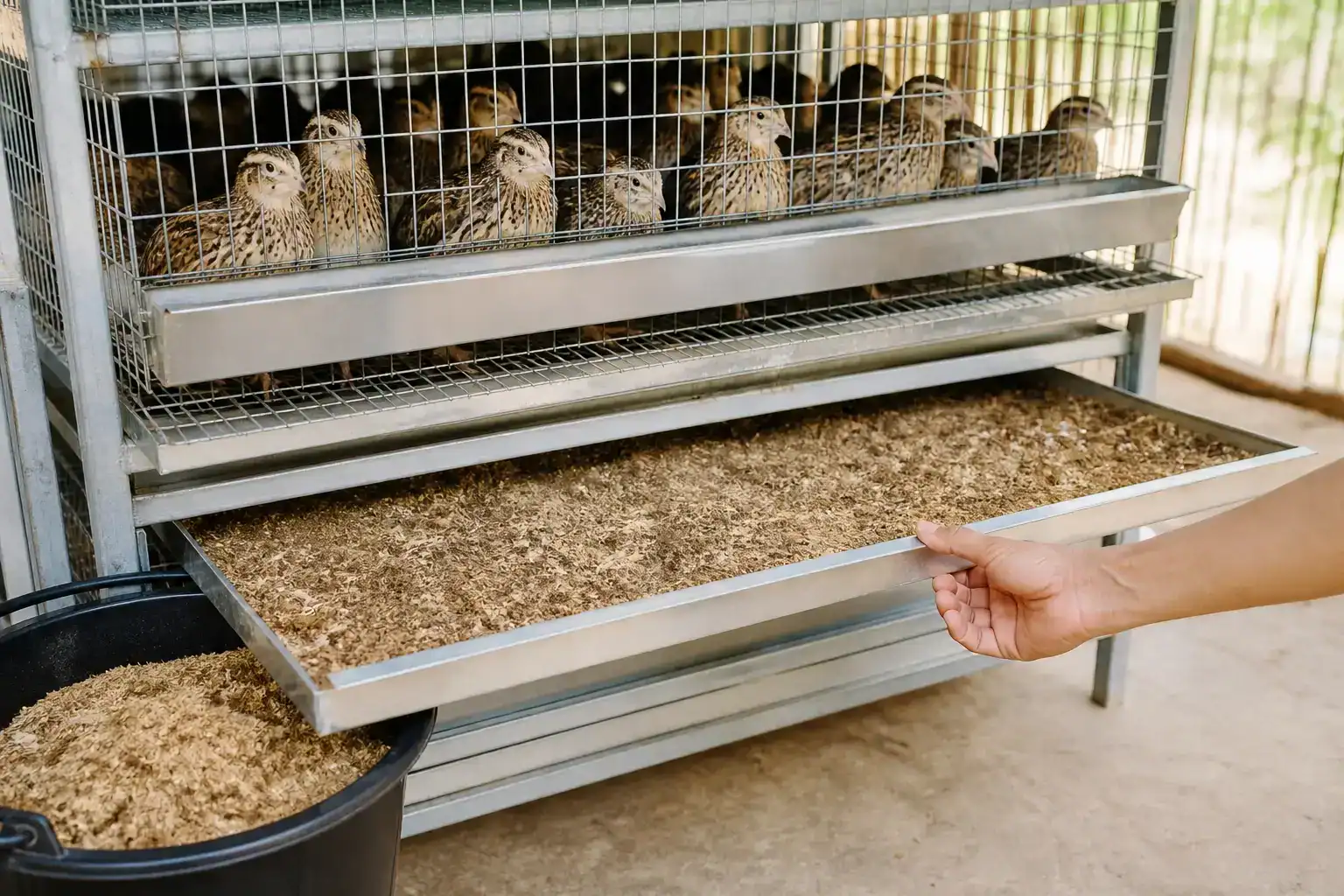
Wire floors are common in production quail cages because droppings fall through to trays, keeping birds cleaner and eggs easier to collect. The floor still has to support small feet. Wire that is too wide, sharp, rusty, or sagging can contribute to foot and leg issues.
Look for smooth, well-supported wire. PVC-coated wire can be easier on feet, but it must hold up to cleaning. Bare galvanized wire can work if the spacing and finish are appropriate. Inspect for sharp cut ends, broken welds, and edges where birds can catch toes.
Give birds a small resting area or enrichment tray if your system allows, but keep it clean. Wet mats or dirty sand trays can create new problems.
Trays and Manure Management
Stacked cages live or die by tray design. Shallow trays overflow. Flimsy trays bend and spill. Trays that cannot slide out cleanly make chores miserable. If the tray gap is too small, droppings pile against the wire floor.
A good tray should:
- Slide out without jamming
- Be deep enough for your cleaning schedule
- Fit tightly enough not to leak everywhere
- Be made from washable material
- Have enough clearance below the birds
- Not block airflow completely
- Be easy to dump into compost or disposal
If the cage will be indoors, odor control is non-negotiable. Clean before ammonia becomes noticeable. If you smell ammonia, the birds are living over it.
Feeders and Waterers
Feed waste is one of the biggest quail costs. A good stacked cage should have feeders that mount securely outside or along the front so birds can eat without scratching feed everywhere. Covered troughs, anti-waste ports, or narrow openings can help.
Waterers are just as important. Cups, nipples, bottles, or troughs can all work if the birds know how to use them and you check them daily. A leaky waterer turns the tray into a swamp. A clogged waterer stops egg production and can kill birds quickly in heat.
If you are debating whether quail can share systems with other poultry, read Can You Raise Quail With Chickens before assuming mixed housing is simpler. For most small-space setups, quail need their own secure housing.
Two Tiers vs. Three Tiers vs. Taller Stacks
Two tiers are easiest to clean and inspect. Three tiers can work well if the top is not too high and trays pull out smoothly. Taller stacks look efficient on paper but often make water checks, bird catching, top-tray cleaning, and airflow harder.
Choose two tiers if: you are new to quail, the cage will be inside a garage or shed, you want easy cleaning, or children or shorter adults will do chores.
Choose three tiers if: you have a proven cleaning routine, the frame is sturdy, airflow is good around every level, and trays are easy to remove.
Avoid tall towers unless you have handled one in person and know you can maintain it.
Indoor, Garage, Shed, or Outdoor Placement
Stacked cages can be placed in several locations, but each has tradeoffs.
A garage protects birds from predators and weather, but ventilation and odor need attention. A shed is similar, especially in summer heat. A covered outdoor area gives airflow, but predators, wind, rain, and temperature swings matter. A basement is usually a poor choice unless ventilation is excellent and local rules allow it.
Wherever you put the stack, plan for:
- Shade
- Airflow
- Predator protection
- Easy hose or bucket access
- Feed storage nearby
- Lighting for chores
- Winter water plan
- Summer heat plan
- Rodent control
- A place to clean trays
The cage footprint is only part of the space. You also need room to work.
Best Use Cases
Stacked quail cages are most useful for Coturnix egg layers, small breeding groups, grow-out batches, keeping color lines separate, garage or shed production, and homesteads with limited ground space.
They are less ideal for keepers who want a naturalistic aviary, people who cannot clean trays often, or anyone who needs a hands-off system. Quail are small, but they are not zero-maintenance.
Product Recommendations
Affiliate disclosure: Waddle and Cluck may earn a commission from qualifying purchases when affiliate links are used, at no extra cost to the reader.
[LASSO BLOCK NEEDED: Two-tier stacked quail cage with pull-out trays and egg roll-out – https://www.amazon.com/s?k=stacked+quail+cage+egg+rollout&tag=writingdete04-20]
[LASSO BLOCK NEEDED: Three-tier quail cage with removable trays for larger small-space setups – https://www.amazon.com/s?k=3+tier+quail+cage&tag=writingdete04-20]
Add quail cage feeder troughs that reduce waste and automatic quail water cups to keep a stacked system running smoothly.
[LASSO BLOCK NEEDED: Wayfair rolling utility cart or outdoor storage cabinet for feed, egg cartons, and cage tools – https://www.wayfair.com/keyword.php?keyword=rolling+utility+cart]
Frequently Asked Questions About Stacked Quail Cages for Small Spaces
Are stacked quail cages good for small spaces?
Yes, stacked quail cages can work very well for small spaces if they have good airflow, easy tray access, safe height, and enough usable floor space.
How many tiers should a quail cage have?
Two tiers are easiest for beginners. Three tiers can work if the frame is sturdy and every tray, feeder, waterer, and bird is easy to reach.
What cage height is safest for Coturnix quail?
Low cages are commonly used for Coturnix because they reduce the force of upward flushing. Avoid awkward mid-height cages that allow birds to hit the ceiling hard.
Do stacked quail cages smell?
They can if trays are not cleaned, waterers leak, or airflow is poor. A well-managed cage should be cleaned before ammonia becomes noticeable.
Should quail cages have wire floors?
Wire floors are common because they keep birds cleaner and let manure fall through, but the wire must be smooth, supportive, and appropriate for quail feet.