
Coturnix quail are the most practical quail breed for homesteaders and backyard producers, and for good reason. They are small, quiet relative to chickens, mature in six to eight weeks, begin laying coturnix quail eggs at six to seven weeks of age, and convert feed to eggs and meat more efficiently than almost any other poultry. A small coturnix quail flock fits in a fraction of the space required for chickens, produces eggs within weeks of purchase, and can be managed on a balcony, in a garage, or in a backyard where chickens would be impractical or prohibited.
What You’ll Learn
Why Coturnix Quail Are the Best Choice for Most Homesteaders
Coturnix quail, also called Japanese quail, were domesticated in Japan over 700 years ago for egg production and have been selectively bred for centuries to maximize laying performance. They are docile, manageable birds that tolerate confinement well, do not require outdoor ranging to thrive, and produce both eggs and meat in a compact, efficient package.
The speed of their production cycle is their defining advantage. A coturnix chick hatched on day one can be producing eggs by week seven. By comparison, a chicken pullet takes 18 to 24 weeks to reach laying age. For a homesteader who wants to see returns quickly on a small investment of time and space, coturnix quail deliver faster than any alternative.
They are also significantly quieter than chickens. Roosters crow. Coturnix males make a soft crow that carries far less than a chicken rooster and is rarely a problem even in suburban settings. Hens are largely silent. This makes coturnix quail viable in many neighborhoods and urban environments where chickens are not.

Coturnix Quail Housing Requirements
Coturnix quail require 1 square foot of floor space per bird as a minimum. This is not a comfortable guideline, it is the threshold below which stress-related problems including feather pecking, aggression, and cannibalism reliably appear. A pen housing 10 coturnix quail needs at least 10 square feet of floor space. More is always better, and 1.5 to 2 square feet per bird produces visibly calmer, more productive birds.
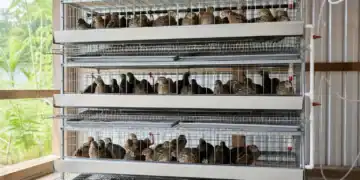
Wire-floored cages are the most common coturnix quail housing setup for production purposes. Wire floors allow droppings to fall through, which keeps the birds clean and dry and reduces ammonia buildup. The wire gauge matters: use 1/2 inch by 1 inch hardware cloth for floors, which supports the birds’ feet without causing the leg injuries that occur with larger mesh openings. Cover a portion of the floor with rubber matting or a solid section to give birds a non-wire resting surface, which reduces the incidence of bumblefoot. We choose not to use this method.
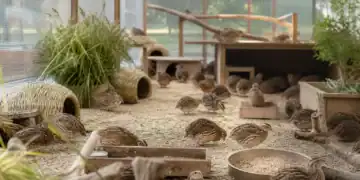
Solid-floor pens with deep litter, pine shavings, or sand are also workable for coturnix quail and produce less leg stress than wire, but require more frequent cleaning to control ammonia. Coturnix quail produce high-nitrogen manure in significant volume relative to their size, and ammonia accumulation in a poorly managed solid-floor pen affects respiratory health and egg production quickly.
Protect coturnix quail housing from all sides, including the top. Coturnix quail flush straight up when startled, a defense instinct from their wild ancestors, and will split their skulls on the top of an uncovered pen. Soft mesh netting or a solid roof prevents this injury, which is one of the most common accidental deaths in coturnix flocks.

Feeding Coturnix Quail
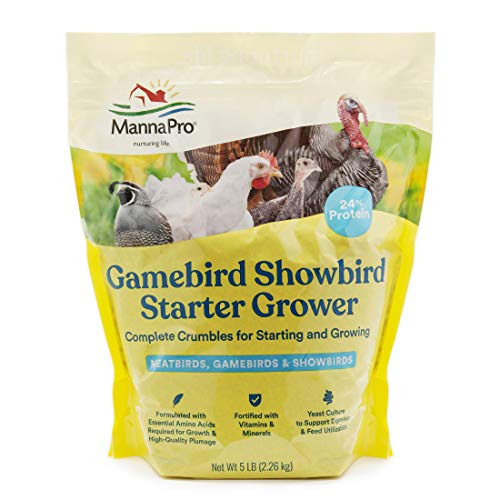
Coturnix quail require a high-protein feed throughout their lives. Feed laying hens a gamebird layer feed with 20 to 24% crude protein. Standard chicken layer pellets at 16% protein are insufficient and will reduce egg production and quality over time. Coturnix quail have higher protein requirements than chickens at every life stage, and cutting corners on feed quality shows up in production numbers within weeks.
Coturnix chicks need game bird starter crumble with 26 to 28% protein for the first six weeks. The small crumble size is important because coturnix chicks have tiny beaks that cannot manage standard chick starter crumble efficiently. Some homesteaders pulse game bird starter briefly in a blender to reduce particle size further for very young chicks.
Fresh water must be available at all times. Coturnix quail drink frequently relative to their size and will reduce egg production within 24 hours of a water interruption. Use nipple waterers or cup waterers rather than open troughs, which coturnix quail routinely walk through and contaminate with droppings.
Provide a shallow container of fine sand or grit for dust bathing. Coturnix quail dust bathe enthusiastically and will use whatever loose substrate is available, including their feed, if no dedicated dust bath is provided. A weekly dust bath opportunity improves feather condition and plumage quality noticeably.
High Protein Complete Feed for Quail, Pheasants, and Ornamental Birds Fortified with Vitamins and Minerals for Growth and Performance 5 lb Bag
Coturnix Quail Egg Production
A healthy coturnix hen at peak production lays one egg per day, accumulating 250 to 300 coturnix quail eggs per year. Production begins at six to seven weeks of age and peaks at eight to twelve weeks. Most coturnix hens maintain strong production through their first year and lay reasonably well into their second, after which production declines significantly.
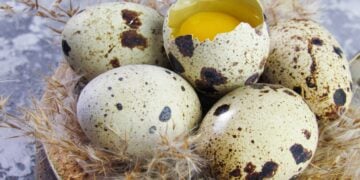
Coturnix quail eggs are roughly one third the size of a standard chicken egg. Five coturnix quail eggs are approximately equivalent to one large chicken egg in volume, though coturnix quail eggs have a proportionally larger yolk-to-white ratio, which gives them a richer flavor many people prefer for cooking. They are used in the same applications as chicken eggs and are particularly prized for pickling, soft boiling, and presentation purposes where their small size is an advantage.
Egg production in coturnix quail is sensitive to light. Hens require 14 to 16 hours of light per day to maintain consistent laying. In winter months when natural daylight drops below that threshold, supplemental lighting on a timer maintains production year-round. A simple 60-watt bulb or LED equivalent on a timer set to maintain 15 hours of total light is sufficient.
Collect coturnix quail eggs daily. Coturnix hens do not go broody and will not sit on accumulated eggs the way some chicken breeds do. Eggs left in the pen are walked on, cracked, and eaten. A roll-away egg tray in a wire cage allows eggs to roll away from the birds immediately after laying, which protects them and makes collection straightforward.

How to Sex Coturnix Quail
Sexing coturnix quail accurately is possible from about four weeks of age using feather coloration in most standard color varieties. In the most common variety, standard brown coturnix, males have a solid rusty-orange chest with no spotting. Females have a lighter, cream-colored chest with distinct black speckles. This color difference becomes reliably visible as juvenile feathering fills in between three and five weeks of age.
The male-to-female ratio in a coturnix flock matters for harmony. One male per three to five females is the standard recommendation. Too many males in a group causes over-mating, which stresses hens and damages feathers on the back and head. A male-heavy group with too few females results in bald, stressed hens within a few weeks.
Males also produce a distinctive soft crowing call that females do not. Once coturnix quail approach maturity at five to six weeks, listening for the male call is a reliable secondary sexing method that requires no handling.
Hatching Coturnix Quail Eggs
Coturnix quail eggs hatch in 17 to 18 days, which is the fastest incubation period of any commonly kept domestic poultry. The short cycle means a homesteader can go from set eggs to chicks in under three weeks, and with a small forced-air incubator, continuous hatching cycles are entirely practical.
Picking the right unit matters for hatch-rate consistency—see our guide to the best incubators for quail eggs for a comparison of popular models.
Set coturnix quail eggs at 99.5 degrees F with 45 to 50% relative humidity in a forced-air incubator. Turn eggs automatically or manually at least three times per day from day one through day 14. Automatic egg turners eliminate the manual work and improve hatch rates by maintaining consistent turning schedules.
On day 15, stop turning the eggs and increase humidity to 65 to 70% for the final lockdown period. This elevated humidity prevents chicks from drying out inside the egg as they pip and zip. Do not open the incubator during lockdown, as this drops humidity and can cause chicks to become shrink-wrapped inside the shell.
Fertile coturnix quail eggs can be stored for up to seven days before setting, with hatch rates declining noticeably after five days. Store eggs at 55 to 65 degrees F with the pointed end down, tilting them slightly once or twice daily to prevent the yolk from adhering to the shell membrane. Do not refrigerate eggs intended for hatching, as refrigerator temperatures damage viability.
According to the Mississippi State University Extension Service, coturnix quail are among the most productive poultry species per square foot of housing space, making them particularly well-suited to small-scale homestead production systems.
A coturnix quail flock of 12 to 20 birds can supply a family with fresh eggs daily, provide surplus eggs for pickling or sale, and produce meat birds on a regular cycle, all within a footprint smaller than most chicken coops. The combination of fast maturity, consistent egg production, and compact housing needs makes coturnix quail one of the most efficient additions a homesteader can make to a small-scale food production system.
For a broader look at getting started with quail on the homestead, see our beginner’s guide to raising quail. Once the birds are ready, there is roasted quail legs with fried potato cubes. The eggs cook faster than you would think — here is how long to boil quail eggs.
Frequently Asked Questions About Coturnix Quail
How many coturnix quail eggs does a hen lay per day?
A healthy coturnix hen at peak production lays one egg per day, totaling 250 to 300 eggs per year. Production begins at six to seven weeks of age and peaks between eight and twelve weeks. Consistent lighting of 14 to 16 hours per day, high-protein feed, and adequate water are the three primary factors that maintain peak production.
How much space do coturnix quail need?
Coturnix quail need a minimum of 1 square foot of floor space per bird. Below this threshold, stress-related problems including feather pecking and cannibalism reliably develop. Providing 1.5 to 2 square feet per bird produces calmer, more productive flocks and is worth the modest additional space if your setup allows it.
How long does it take coturnix quail eggs to hatch?
Coturnix quail eggs hatch in 17 to 18 days at 99.5 degrees F with 45 to 50% humidity during incubation. Increase humidity to 65 to 70% during the final three-day lockdown period. Do not open the incubator during lockdown, as the humidity drop can cause chicks to become stuck inside the egg during hatching.
Are coturnix quail eggs the same as regular quail eggs?
Coturnix quail eggs are the most common quail eggs sold commercially and in farm markets. They are roughly one third the size of a chicken egg with a proportionally larger yolk, a richer flavor, and a thinner shell. Five coturnix quail eggs approximate one large chicken egg in volume. They are used in all the same ways as chicken eggs and are particularly popular for pickling and soft boilin
How do you tell male and female coturnix quail apart?
In standard brown coturnix, males have a solid rusty-orange chest with no spotting. Females have a cream-colored chest with distinct black speckling. This difference becomes reliably visible as juvenile feathering fills in between three and five weeks of age. Males also produce a soft crowing call that females do not, which becomes audible as birds approach maturity at five to six weeks.