
A healthy, established hive commonly produces 30 to 60 pounds of surplus honey in a year, and in a strong nectar flow with generous forage it can climb to 80 to 100 pounds or more. So when you ask how much honey does one hive produce, the honest answer is that it swings with your season, your region, and the strength of the colony.
Your first year usually yields little to nothing, because a new colony pours its energy into building comb and growing its population. From the second season on, a well-managed hive in a decent location becomes a dependable producer. The numbers below give you a realistic range to plan around, plus the factors that move a hive toward the high end.
What You’ll Learn
How Much Honey Does One Hive Produce in a Typical Year
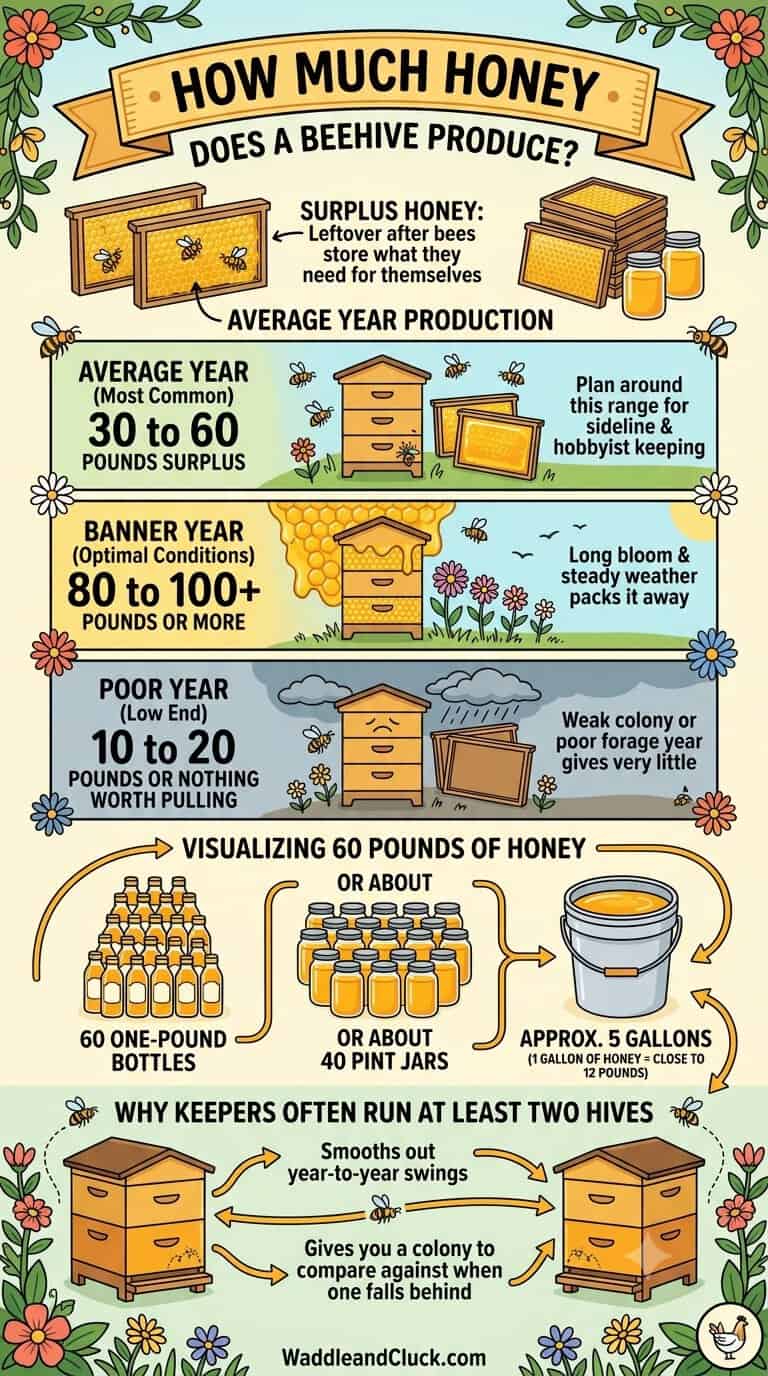
A productive, established hive gives you 30 to 60 pounds of surplus honey in an average year, which is the honey left over after the bees have stored what they need for themselves. That range is the working figure most sideline and hobby beekeepers plan around. In a banner year, with a long bloom and steady weather, a single strong colony can pack away 80 to 100 pounds or more of surplus. On the low end, a weak colony or a poor forage year might give you 10 to 20 pounds, or nothing worth pulling.
To picture it, 60 pounds of honey fills roughly 60 of the common one-pound bottles, or about 40 pint jars. A gallon of honey weighs close to 12 pounds, so a 60-pound harvest is about five gallons off one hive. Those totals explain why many keepers run at least two hives: it smooths out the year-to-year swings and gives you a colony to compare against when one falls behind.
Why Your First Year Usually Yields Little to No Honey
Plan for a first-year harvest of zero, and treat anything you get as a bonus. A new colony started from a package or a nuc arrives with a few thousand bees and no drawn comb, and drawing wax comb is expensive work: bees eat roughly 6 to 8 pounds of honey to produce 1 pound of wax. Before the colony can store a surplus for you, it has to build out the brood nest, raise a strong population, and fill enough frames to survive its first winter.
That is the right order of priorities, and pushing against it backfires. If you harvest aggressively in year one, you risk leaving the bees short for winter and losing the colony outright. A first-year hive installed in early spring will spend April through July on comb and brood, and by late summer it is stocking the pantry for the cold months rather than for you.
Getting a colony to this point is the whole aim of a strong start, which is why our guide on how to start beekeeping leans so hard on feeding and comb-building that first season. A nuc, which comes with drawn comb and an already-laying queen, sometimes produces a small surplus of 10 to 20 pounds in year one, but a package rarely does.
What Determines How Much Honey a Hive Makes
Five factors set your ceiling, and they interact: forage, climate, colony strength, weather during the flow, and your management. Understanding each one tells you whether your yard is set up for a 30-pound year or a 90-pound year.
Forage and Climate
Bees can only bank what the landscape offers, so the density and variety of blooming plants within about a 2-mile radius of the hive is the single biggest driver. A colony surrounded by clover, wildflowers, tulip poplar, orchards, or a productive nectar crop will out-produce an identical colony in a mowed suburban block or a forage desert.
Regional climate sets the length of the season: a long, warm growing season with a reliable major flow gives bees more weeks to gather than a short northern summer does. You can nudge your forage upward by planting for pollinators, and our roundup of the best plants for bees covers what actually earns its space.
Colony Strength and Weather
A hive needs a large population of foragers timed to peak exactly when the nectar flow hits, which is why disease, mites, and a failing queen quietly cap yields. A colony weakened by varroa or running a poor queen simply does not field enough foragers to capitalize on the bloom. Weather during the flow then decides how much of that potential turns into honey: nectar production depends on warmth, soil moisture, and sunshine, and a cold snap or a stretch of rain during the main flow can erase weeks of foraging.
Keeping the colony populous and healthy going into the flow is the part you control, and our notes on maintaining a healthy beehive walk through the inspections that catch problems early. It also helps to understand how bees make honey from raw nectar, because the ripening process is why timing the flow matters so much.
How Do You Estimate What One Hive Will Produce
Start with a conservative baseline of 30 to 40 pounds for a healthy second-year hive in average forage, then adjust up or down based on what your local beekeepers report. The most reliable number you can get is the local one: members of a county beekeeping club or a nearby extension apiary know what a typical hive pulls in your area, and that figure beats any national average. Your state extension service is a strong source here, and Penn State Extension’s honey bee resources publish region-specific guidance on flows and yields.
From there, read the hive itself during the season. A colony that has filled two deep brood boxes and is capping honey in a super by early summer is on track for an above-average year, while one still working on its first box is not. Hefting the hive from the back, or putting it on a scale, tells you week to week whether nectar is coming in. Watching a full super fill and get capped is also your cue on timing, and knowing when to harvest honey keeps you from pulling frames the bees have not finished ripening.
How Much Honey Should You Leave the Bees for Winter
Leave your bees enough stores to survive winter before you count a single jar as yours, and that amount depends heavily on your climate. In the cold northern United States and Canada, a colony needs roughly 60 to 90 pounds of honey to overwinter, which is often an entire deep box left full. In mild southern regions, 30 to 50 pounds may carry a colony through, since the cluster burns less fuel and forage returns sooner.
Only the honey above that survival threshold is your surplus, and this is exactly why the same hive that produced 80 pounds might only give you 30 to leave the bees safe. Weigh the hive in fall, and if it is light, feed sugar syrup to top it up rather than harvesting to the edge. A colony that starves in February costs you far more than the honey you would have pulled in September, both in bees and in the price of replacing them.
Once you know your realistic surplus, the decision framework is straightforward: expect nothing your first year, budget 30 to 60 pounds from an established hive in an average season, run at least two colonies to buffer the swings, and always subtract your region’s winter stores before you plan your harvest. Track what each hive actually gives you across a few seasons, and you will have a yield estimate for your own yard that beats any general figure. Whatever that number turns out to be, plan for some of it to leave as gifts and the rest to go into things that keep, like herb infused honey.
Frequently Asked Questions About How Much Honey Does One Hive Produce
How much honey does a hive produce in its first year?
Usually little to none. A new package or nuc spends its first season drawing comb and building population, so plan for a zero harvest and treat any surplus as a bonus. A nuc with drawn comb occasionally gives 10 to 20 pounds in year one, but a package rarely does.
How many jars of honey is 60 pounds?
About 60 of the common one-pound bottles, or roughly 40 pint jars. Since honey weighs close to 12 pounds per gallon, a 60-pound harvest is about five gallons from a single hive.
Can one hive produce 100 pounds of honey?
Yes, in a strong year. A populous, healthy colony in a region with abundant forage and a long, warm nectar flow can bank 80 to 100 pounds or more of surplus. That is the high end, though, not what you should count on in an average season.
How much honey should I leave my bees for winter?
In cold northern climates, leave roughly 60 to 90 pounds so the colony can survive until spring forage returns. In mild southern regions, 30 to 50 pounds is often enough. Weigh the hive in fall and feed syrup if it comes up light.