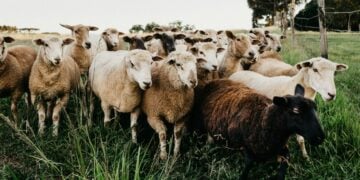

Raising sheep is one of the more approachable ways to add large animals to a homestead. They are smaller than cattle, calmer than pigs, and considerably less determined to escape than goats. A small flock of four to eight ewes and a ram can produce lamb meat annually, improve your pasture with their manure, and give you real experience with the rhythms of livestock keeping that translates to everything else you raise. The learning curve is real, but it is manageable if you go in with the right expectations.
Temperament matters as much as production goals, especially when choosing docile sheep breeds for a first flock.
What You’ll Learn
How Much Land Sheep Need
The standard guideline for raising sheep is four to six ewes per acre of well-managed pasture in a temperate climate. That number shifts based on pasture quality, rainfall, breed, and how well you manage the land. Poor or sandy pastures support fewer animals. Rich, well-maintained pastures in moderate climates can support more.
Rotational grazing makes a meaningful difference and is worth setting up from the beginning. Dividing your pasture into two or three paddocks and moving the flock every two to three weeks gives each section time to recover before the sheep return. That rest period benefits the grass and, just as importantly, it breaks the lifecycle of internal parasites. Infective barber pole worm larvae deposited through droppings become significantly less viable after a few weeks of rest and sun exposure.
Sheep also need a dry, draft-free shelter year-round. They handle cold reasonably well, but rain combined with wind is genuinely dangerous for them and causes more hypothermia deaths than cold alone. A three-sided shed that blocks wind and driving rain is adequate for mature sheep in most climates. Newborn lambs need more protection and should arrive in a shelter with solid walls and clean dry bedding.

Starting Flock Size
Sheep are among the most social animals on the homestead and genuinely suffer without adequate company. A single sheep kept alone will pace, vocalize, and fail to thrive no matter how well it is fed. Two sheep are better but still prone to distress when separated for any reason.
Routine handling becomes much safer when sheep are comfortable wearing a properly fitted halter and walking on a lead.
Three ewes is the minimum worth starting with. Four to six is a more practical working flock — large enough to observe normal flock dynamics, manage variation in individual animals, and produce a meaningful quantity of lamb each year. Most homesteaders find that four to eight ewes plus a ram is the sweet spot: productive enough to be worth the effort and small enough to manage comfortably with one person.
For a first-time sheep keeper, a small group of grade or commercial ewes with a known lambing history is a better starting point than unproven yearlings. An ewe that has lambed before is a more reliable animal in her first season on your property than a first-timer whose maternal behavior is still unknown.
Sheep Health Basics
The most important health practice for raising sheep is monitoring body condition and managing internal parasites. Barber pole worm is the primary health threat to sheep in humid regions of North America and the leading cause of sheep deaths on homesteads that are not actively managing parasite loads.
FAMACHA scoring is the tool that makes parasite management practical. It involves checking the color of the lower eyelid membrane to estimate anemia caused by barber pole worm feeding on blood. Animals scoring in the at-risk range get treated. Animals that are managing well do not. This targeted approach is far more effective than treating the entire flock on a calendar schedule, which is one of the main drivers of anthelmintic resistance in sheep parasites. Score each sheep monthly during the grazing season.
Hoof trimming is required two to four times per year for most sheep. Overgrown hooves cause lameness and joint damage, and the problem compounds quickly if you fall behind. Sheep on wet or moist ground need more frequent attention than those on dry, rocky pasture that naturally wears hooves down. Learn the basic trimming technique before your animals arrive and have shears on hand from day one.
Regular hoof checks also help you catch overgrowth before trimming sheep hooves becomes a difficult corrective job.
The baseline vaccination for homestead sheep is CD&T, which covers Clostridium perfringens types C and D and tetanus. Ewes are vaccinated four to six weeks before lambing to boost the antibody levels in their colostrum, which protects newborn lambs. Lambs begin their own CD&T series at 6 to 8 weeks of age.
The Annual Raising Sheep Calendar
The homestead sheep year follows a predictable rhythm once you understand it. Here is what that looks like for a standard fall-breeding flock in a temperate climate.
September to November is breeding season. Ewes come into estrous cycles as days shorten, and a ram introduced to the flock in September or October will breed ewes as they cycle. Mark the date the ram goes in — sheep gestation is 147 to 150 days, which lets you calculate when to expect lambs.
Before breeding, learn how long sheep are pregnant so lambing dates do not arrive as a surprise.
February to April is lambing season. Most fall-bred ewes lamb in late winter or early spring, which times milk production to align with the spring pasture flush. This timing supports both ewe nutrition and lamb growth naturally. Have lambing areas bedded and ready before your first expected date.
April to June is lamb growth and ewe recovery. Lambs grow fast on milk and spring grass. Ewes rebuild the body condition they lost through late pregnancy and lactation. If you are targeting early market weights, begin creep feeding lambs with quality forage or grain.
June to August is weaning. Lambs are weaned at 60 to 90 days. Remove the ewes from the group rather than pulling lambs, which lets lambs stay in familiar surroundings while ewes dry off over one to two weeks.
August to November is finishing and marketing. Lambs reach market weight of 100 to 130 pounds at 5 to 7 months on good nutrition. Those not kept for breeding replacements are sold through farm direct channels, livestock auctions, or home processing.

Buying Your First Sheep
Buy from a source where you can see the animals before purchase, ask about vaccination and deworming history, and observe the conditions they have been raised in. Auction barn sheep carry higher disease risk and unknown parasite management history. The savings rarely offset the problems.
Check each animal’s FAMACHA score and watch how it moves before committing to the purchase. A thin, lethargic sheep with nasal discharge, labored breathing, or obvious lameness is not a good first purchase at any price. You are looking for alert, well-conditioned animals that move freely and hold their heads up.
According to the American Sheep Industry Association, the most common reasons homestead sheep enterprises fail in the first two years are inadequate fencing, underestimating parasite management requirements, and starting with too few animals to observe normal flock behavior. All three are avoidable with good preparation. Sheep and goats get compared constantly, and the difference comes down to diet and fencing: sheep graze, goats browse, and a fence that holds one will not always hold the other. If you are choosing between them, start from that.
For more on setting up your perimeter, see our sheep fencing guide.
Frequently Asked Questions About Raising Sheep
How many sheep can you keep per acre?
Four to six ewes per acre is the standard guideline for well-managed temperate pasture. Rotational grazing with two or three paddocks increases that carrying capacity and is strongly recommended. Poor pasture, dry climates, or continuous grazing without rotation requires reducing stocking density to keep both pasture and animals in good condition.
What is the easiest sheep breed for beginners?
Katahdin hair sheep are widely considered the most beginner-friendly choice for homesteaders focused on meat production. They shed naturally without shearing, show better parasite resistance than most wool breeds, and have reliable maternal behavior. For wool production, Icelandic sheep are manageable and dual-purpose with strong breed support.
How long do sheep live?
Sheep live 10 to 12 years on average, though productive lifespan in a meat operation is typically 5 to 7 years before ewes are replaced with younger animals. Ewes are most productive between ages 2 and 6. After age 7 or 8, tooth wear reduces grazing efficiency and production declines.
Do sheep need a companion animal?
Sheep need other sheep. They do not substitute other species for the social needs that flocking behavior provides. A sheep kept with goats or horses will be calmer than one kept alone, but it is still stressed compared to a sheep kept with its own kind. Keep a minimum of three sheep together.
When is the best time to buy sheep?
Late winter or early spring, after lambing season wraps up, is a practical time to purchase ewes with known lambing performance from the season just completed. You can evaluate maternal behavior, milk production, and lamb growth before committing long-term. Fall purchases of bred ewes let you observe your first lambing season within a few months of acquisition.