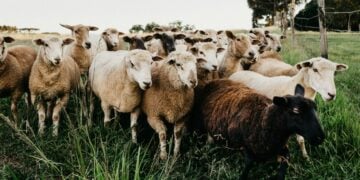

Hair sheep breeds have become one of the most practical developments in small-scale sheep keeping in recent decades. Unlike traditional wool breeds that require annual shearing, regular crutching, and ongoing fleece management, hair sheep shed their winter coat naturally each spring without human intervention. This eliminates one of the most time-intensive and skill-dependent aspects of sheep husbandry and makes hair sheep genuinely lower-maintenance than their wool counterparts.
Icelandic sheep are worth comparing when you want one hardy wool breed capable of producing both meat and useful fiber.
For homesteaders focused on meat production who do not want to learn shearing or manage fleece as a secondary enterprise, hair sheep breeds are the most straightforward path into sheep keeping.
Key Takeaways
What Are Hair Sheep?
Hair sheep are sheep breeds that grow a coat composed primarily of coarse hair rather than fine wool fibers. In winter, hair sheep develop a dense undercoat that provides insulation in cold weather. As temperatures rise in spring, this undercoat naturally sheds without assistance. Some individual animals shed more completely than others, and a small number may retain patches of undercoat that benefit from light hand-removal, but no shearing equipment or trained shearer is required.
The coat of a hair sheep is not suitable for textile production in the way that wool fleece is, which means hair sheep keepers are not producing a fiber product alongside their meat. For homesteaders who want to sell or spin fleece, hair sheep are not the right choice. For those raising sheep specifically for meat with no interest in fiber, the absence of a shearing requirement is a significant practical simplification.
Hair sheep are found across multiple continents and have been kept for thousands of years in warm and tropical regions where wool breeds would be poorly suited. Many modern American hair sheep breeds were developed specifically for their combination of meat production qualities, heat tolerance, parasite resistance, and reduced management requirements.
Katahdin Sheep
The Katahdin is the most widely kept hair sheep breed in the United States and the most commonly recommended starting point for homesteaders new to sheep. Developed in Maine in the 1950s and 1960s by crossing various breeds including the St. Croix hair sheep with Suffolk and other wool breeds, the Katahdin was specifically designed for productive, low-maintenance meat production in North American conditions.
Katahdin sheep are medium-sized, with ewes weighing 120 to 160 pounds and rams reaching 180 to 250 pounds. They are white or patterned, and the rams are polled, which is a significant handling advantage. Katahdins are known for excellent maternal instincts, with ewes that lamb with minimal assistance, produce good milk for lambs, and are attentive mothers. Lambing percentage in well-managed Katahdin flocks averages 175 to 200%, meaning most ewes produce twins or triplets.
Katahdin sheep show notably better resistance to barber pole worm and other internal parasites than most wool breeds, which is one of the most significant health management advantages of the breed in humid climates where parasite pressure is high. They are not immune to parasite infestation and still require FAMACHA scoring and targeted deworming, but the burden is meaningfully lower than managing a wool flock in the same environment.
Katahdin lamb meat is mild-flavored with a lean, well-muscled carcass. Lambs reach market weight of 100 to 130 pounds at 5 to 7 months of age on good pasture with creep feeding. Carcass quality is good, with a clean, white fat that buyers and processors respond well to.

Dorper Sheep
The Dorper is a South African hair sheep breed developed in the 1930s from Dorset Horn and Blackhead Persian crosses for meat production in arid, demanding conditions. Dorpers are among the fastest-growing sheep breeds available and produce one of the highest quality lamb carcasses of any breed, which has driven their rapid adoption on American homesteads and commercial operations since the 1990s.
Dorpers come in two color varieties: the standard Dorper, which has a black head and white body, and the White Dorper, which is entirely white. Both varieties perform identically as production animals. Adult ewes weigh 150 to 200 pounds and rams reach 200 to 280 pounds. Dorpers are heavier-framed than Katahdins, which means they produce more carcass weight at the same age but require more feed to maintain condition.
The Dorper’s growth rate is its defining production advantage. Well-fed Dorper lambs reach 100 pounds in 90 to 120 days, significantly faster than most other breeds. This rapid growth makes Dorpers particularly attractive for homesteaders who want to produce finished lambs in a compressed time window or who are selling to ethnic meat markets where heavy, quickly finished lambs command premium prices.
Dorper ewes have reasonable maternal instincts but are not universally considered as attentive as Katahdins. Lambing percentage averages 130 to 150% in well-managed flocks, somewhat lower than Katahdin. Their parasite resistance is moderate but generally better than wool breeds, though not quite at the level of Katahdin or Barbados Blackbelly crosses in high-humidity environments.

Barbados Blackbelly and American Blackbelly
The Barbados Blackbelly is a Caribbean hair sheep breed with exceptional parasite resistance and heat tolerance that makes it one of the most studied breeds in parasite resistance research. Pure Barbados Blackbelly rams are polled and have a distinctive tan and black coloring with black belly markings. They are smaller than Katahdin or Dorper, with ewes weighing 80 to 100 pounds, which limits their usefulness as a pure meat breed.
The American Blackbelly is a cross between the Barbados Blackbelly and Rambouillet or Mouflon that adds horn development and size while retaining the exceptional parasite resistance of the Barbados genetics. American Blackbelly rams are horned and larger than pure Barbados, making them more useful in a production context.
Many homesteaders use Barbados Blackbelly or American Blackbelly rams over Katahdin or Dorper ewes specifically to improve parasite resistance in crossbred lamb crops. The crosses produce animals with significantly better FAMACHA scores than either parent breed alone in high-pressure parasite environments, which reduces the deworming input required to maintain healthy lambs through summer.

St. Croix
The St. Croix is a Caribbean hair sheep breed recognized as one of the purest parasite-resistant hair sheep available in North America. St. Croix sheep are white, polled, medium-sized, and extremely hardy. They are one of the foundational breeds used in the development of the Katahdin and have been extensively studied for their parasite resistance genetics.
St. Croix sheep are not the fastest-growing breed available, and their carcass conformation is less muscled than Dorper or Katahdin. For homesteaders in humid climates with severe parasite pressure who are willing to accept slightly longer lamb finishing times in exchange for maximum parasite resistance and minimal deworming requirements, the St. Croix or St. Croix crosses are worth considering seriously.

Choosing the Right Hair Sheep Breed for Your Homestead
For most homesteaders new to sheep, the Katahdin is the most practical starting point. It is widely available across North America, has strong breed support through the Katahdin Hair Sheep International registry, combines excellent maternal behavior with good growth and parasite resistance, and is well-documented in homestead and small farm management contexts.
For homesteaders prioritizing the fastest possible lamb growth and best carcass quality with some tolerance for slightly more intensive management, the Dorper or Katahdin-Dorper cross is the better choice. Many homestead operations run Dorper rams over Katahdin ewes to capture hybrid vigor along with both breeds’ complementary strengths.
According to Katahdin Hair Sheep International, the Katahdin breed consistently ranks among the top performing breeds in National Sheep Improvement Program data for parasite resistance, maternal traits, and growth rate combined, which reflects the breed’s specific development for practical small-scale production systems.
For more on feeding your hair sheep flock, see our guide to what sheep eat.
Frequently Asked Questions About Hair Sheep Breeds
Do hair sheep really not need shearing?
Yes. Hair sheep shed their winter undercoat naturally each spring without human assistance. No shearing equipment, trained shearer, or annual shearing appointment is required. Some individual animals shed less completely than others and may benefit from light hand-removal of retained patches, but this is a minor exception rather than a routine management requirement.
Are hair sheep good for meat?
Yes. Hair sheep breeds produce mild-flavored, lean carcasses that are well-received in both direct farm sales and ethnic meat markets. Katahdin and Dorper lambs in particular produce clean, white fat and well-muscled carcasses that grade well. Hair sheep meat does not have the strong mutton flavor sometimes associated with wool breeds, which broadens its market appeal.
What is the most parasite-resistant hair sheep breed?
The Barbados Blackbelly and St. Croix are consistently identified in research as the most parasite-resistant hair sheep breeds available in North America. The Katahdin shows significantly better parasite resistance than most wool breeds and is more productive and widely available than pure Barbados Blackbelly or St. Croix. For maximum parasite resistance in a productive meat sheep program, Katahdin crossed with Barbados Blackbelly or American Blackbelly genetics is a well-supported strategy.
How fast do hair sheep lambs grow?
Katahdin lambs reach market weight of 100 to 130 pounds in 5 to 7 months on good pasture with grain supplementation. Dorper lambs reach 100 pounds in 90 to 120 days under optimal conditions, making them one of the fastest-growing sheep breeds available. Growth rate varies with nutrition, management, and individual genetics.
Can hair sheep handle cold winters?
Yes. Hair sheep develop a dense winter undercoat that provides meaningful insulation in cold weather, then shed it naturally in spring. Katahdin sheep were developed in Maine specifically for cold-climate production and handle northern winters without heated shelter when provided with dry, draft-free housing and adequate nutrition. Dorpers are less cold-hardy than Katahdins and benefit from more substantial shelter in very cold climates.